
Our guest today is an author whose path to fiction is as unconventional as the stories he writes. After earning a degree in religious studies and philosophy, he initially came to Harvard Divinity School intending to become a New Testament scholar. Instead, he transferred to Harvard Law School and went on to build a career as a lawyer – while continuing to write fiction simply for the love of storytelling.
Raised partly on the Colville Reservation in Washington, where his father was a tribal leader and member of the Colville Tribe, he brings a diverse personal and intellectual background to his work. He is the author of the Win the Rings trilogy, numerous short stories, and now Fight Song, his first novel published by Swift Water Books, an imprint of Penguin Random House Canada.
A lifelong reader of science fiction and fantasy, he gravitates toward strong female protagonists, unlikely heroes, mythology, adventure, and characters who defy the usual “chosen one” formula. He also happens to read Greek and Latin, is a passionate hockey fan and Red Sox supporter, and has visited every U.S. state except Hawaii.

Fight Song introduces readers to Nokes Lasley, an exceptionally talented Indigenous hockey player whose dreams collide with the realities of the foster care system. What first inspired Nokes’ story, and why was it important to explore elite athletics alongside issues of displacement, trauma, and resilience?
Yeah, what’s with all the hockey? For Nokes, life is a battle to be fought. Hockey is that too. How she survives and wins on the ice is a nice parallel to what she has to do to survive in life.
As for inspiration, the biggest was one of my favorite hockey players: Chris Simon. I saw him play many times. He was an elite indigenous hockey phenom who clawed his way up through the ranks and into the NHL, where he won a Stanley Cup with the Colorado Avalanche. For all his success, he had his demons and struggled with anger. The book was already done when he tragically committed suicide, a dark day that cast a pall over the story for me at the time. Although Nokes’ life is not modelled on his, she is fighting many of the same battles he did.
Indigenous athletes are underrepresented in all sports, but certainly hockey. Not because the talent isn’t out there; it’s just a tougher road. An additional hurtle for Nokes, of course, is that she’s a girl. It’s been such a joy the last few years watching women’s professional sports really come into its own. Finally.
Nokes is a compelling protagonist because she’s fiercely independent, often guarded, and not always easy to like. How did you approach creating a character whose strength is inseparable from her anger and vulnerability, and what challenges came with writing someone so emotionally complex?
The goal with Nokes was to give the reader honesty and authenticity. That meant showing the good, the bad, and the ugly. Readers can relate to that. The things you and I share with Nokes far outnumber the things that differ. We’re all emotionally complex. We’re all not easy to like sometimes. So, I wanted to just present her like she is, and if I could pull that off, I thought people would take to her as “one of our own.” She wasn’t intended to be a role model. She does what she must to survive, and it isn’t always pretty.
Your own childhood included living near the Colville Reservation, where your father served as a tribal leader. In what ways did your personal experiences and connection to Indigenous communities influence the emotional authenticity of Fight Song, particularly Nokes’ journey toward understanding her heritage?
Actually, we lived on the reservation. Living near it, as opposed to on it, would have been living in a very different world. So, the story here was that my father left the reservation after high school and later moved his family around a lot, rarely staying anywhere for more than a year or two at most. We were nomads, never putting down roots anywhere. Then, while we were still young, he decided to go back to his roots and took us to live in the middle of the Colville reservation near the town of Nespelem. Huge culture shock for me, establishing connections with a heritage that I knew virtually nothing of before then. When I developed Nokes’ character, I decided to stay as close to what I knew and experienced as possible. Her impressions and memories of the reservation were mine. For example, some of the names used – Enions Impekin, e.g. — are the names of my ancestors.
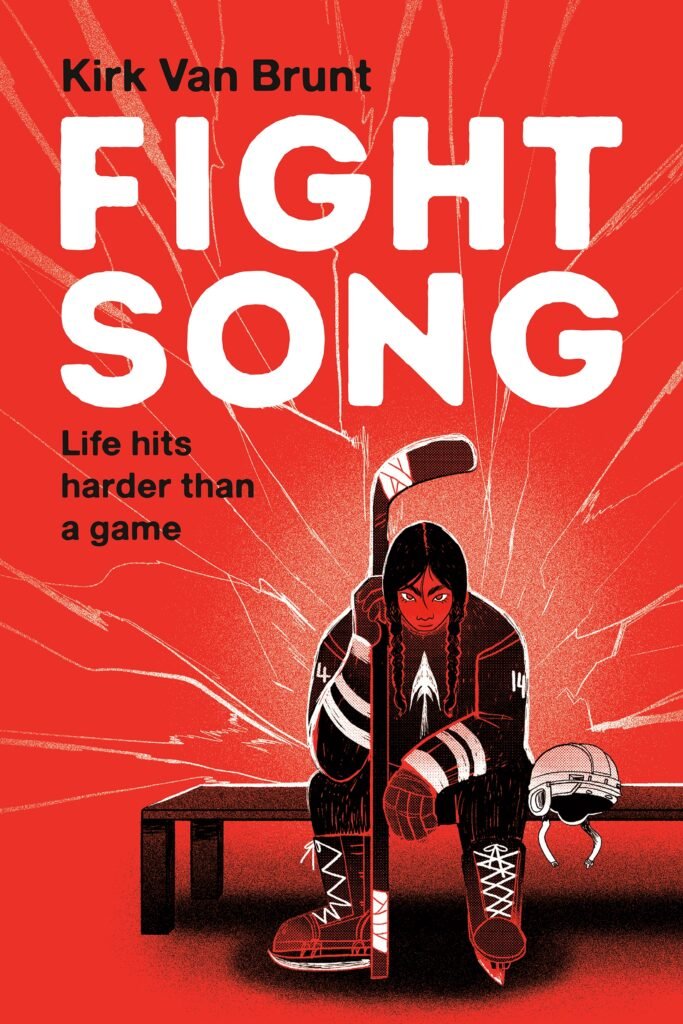
Hockey is more than a sport in this novel – it becomes a source of identity, hope, and escape. How did you balance the authenticity of competitive hockey with the emotional and psychological journey at the heart of the story, and did you find that one informed the other during the writing process?
I call it the Tau of Hockey. The mental, physical struggles of playing hockey kind of reflect the larger struggles of life. The things you need to find your equilibrium on the ice say a lot about achieving balance and finding peace in the larger world. At least, that’s what I tried to reflect in the story.
The novel tackles difficult subjects, including the foster care system, abuse, and the long-lasting effects of instability, while still maintaining a sense of hope. What kind of research and reflection went into portraying these experiences responsibly, especially for a young adult audience?
I wrote about what I’ve seen. Not everything in the story is based on firsthand experience in all details, but much of it is. For the record, though, I grew up in a mostly stable, two-parent household. Many of my friends didn’t. Too many didn’t make it much past high school. If Nokes was going to deal with these kinds of experiences, The only way to not sound fake or preachy was to not pull any punches.
I thought a lot about how candidly to talk about the difficult experiences Nokes has. In the end, I decided the audience could handle it and, indeed, would insist on it. Also, an important part of the story is Nokes finding the courage to speak up about what happened to her. It felt like I would be doing her story a disservice if I cringed away from speaking plainly and frankly. That being said, the team did decide that it was appropriate to provide a content warning.
At its core, Fight Song seems to ask what it truly means to find a place where you belong – whether through family, community, culture, or sport. After spending so much time with Nokes’ story, what do you hope readers carry with them long after they finish the novel, and what did writing this book teach you as both a storyteller and a person?
Short answer: Her song is my song. It’s your song too.
INTERVIEW: YA SH3LF