
K. Ancrum, is an author of speculative contemporary Young Adult Fiction. She is best known for the LAMBDA award winning ICARUS and the National Book Award nominated THE CORRUPTION OF HOLLIS BROWN. K. is a Chicago native who is passionate about reflective representation in young adult fiction, and exploring the edges of what is possible within her chosen genre. She currently writes most of her work in the lush gardens of the Chicago Art Institute.
Adam, Mine. has been described as both a “love letter to Frankenstein” and a deeply personal reimagining of the relationship between Victor Frankenstein and his creation. What drew you back to Mary Shelley’s original text, and what did you feel contemporary YA – and queer literature in particular – could still uncover within that story?
I wanted to write a story about the complex and tight timeline between adulthood and childhood. Not the growing up part, but the actual line of divide that we all hit at some point where we realize we have crossed a line and must change the way we act and react. Frankenstein is a God/Man Father/Son, Motherhood Complex story of course, but it also focuses considerably on personal transformation, a bid for understanding, the realization of irretrievable sin and love, hate and violence as permanently altering forces. As a children’s writer, I have a vested interest in Children’s Concerns and Experiences. So I wanted to present them with a Victor who fails and cheats. Who does something selfish and impulsive to soothe his childish pride, both of which are events so universal I’d be surprised to meet a teen who has not lived through them. The rest of the story is about what Happens Next: The realization that he has erred beyond the acceptance of those he considers his peers, the true and visceral threat to his life, the recognition that he has harmed someone irreparably and that this person deserves retribution, a Green Knight Gawain level understanding that he has in fact this—despite his overwhelming fear of it, learning to make amends, learning selflessness is a part of making amends, losing his fear of punishment and turning towards his Monster in the end like a sunflower turning towards the sun.

Unlike many Frankenstein retellings that focus primarily on horror or science fiction, this novel seems equally invested in grief, forgiveness, and emotional tethering between Victor and Elias. How did you approach reframing the “monster” narrative through intimacy and shared emotional experience rather than pure fear?
I think that a Victor who is very young from beginning to end (17) is a Victor who deserves a second chance to address the grievances of the person he hurt. The element that truly drives this novel is a rumination on what it means to become a man and what does a man (an adult responsible party, acting with an understanding of justice, fairness, goodness) do in the face of their own wicked actions. Victor experiences the classic Frankenstein journey of travel and transformative conversation, but instead of a roiling punishment followed by acts of terror violence and resistance, I wanted it to be more like a rough education. Victor in Adam Mine experiences plenty of terror and violence on his journey, but his resistance wears away and he begins to learn. And only when he has learned is he able to behave as an adult and construct his amends from the position of an adult.
Discussing The Monster is difficult without major spoilers, but I will try. The perspective of the monster is that of someone who is roughly Victor’s age, but due to socioeconomic and regional structure, has been considered a man for quite a while. His reactions to Victor’s crime against him is a raw outcry of grief equal to the grief of the birth process in the original book and his retribution is similarly violent as well. But he too is on a journey of understanding: understanding himself and his potential, reformatting Justice for himself outside of his community, and deciding how to express his pain when he meets Victor again. They are in essence, two beings untethered from their communities, lost in a dark ocean of feeling and both very far from home. They deserve intimacy and a lifeline, and an opportunity to understand each other, and the other “real/older” adults in the book understand that.
Also!!! This book is about science as well. Specifically, it is about physics! There is a lot about the concept of Magic as Science Untimely in the beginning of the book as a stage set for the eventual reveal of Metaphysics as a type of science instead of a true magic. So Victor’s engagement with The Monster (raising from the dead/their bond/anything like that) is presented as a type of interference in fifth dimensional space, which is why the most impactful interventions are wave/resonance specialists and Chemical Physicists. That part of the book is kind of going over people’s heads a bit haha. But the thing about being a writer is that you don’t know what your audience doesn’t know until they’re reading your book like “???”
Your books often experiment with structure and form, and Adam, Mine. returns to the vignette-style storytelling readers saw in works like The Wicker King and Icarus. What does that fragmented, impressionistic format allow you to accomplish emotionally or psychologically that a more traditional narrative structure would not?
So much!!! The first and most obvious is the “one big gulp” situation. Which is that a large amount of people read my books in one or two sittings, which allows me to pull them on an emotional journey that feels almost cinematic. I have them gripped from the moment they sit down until they get up again, shaky and new.
The second is the powerful impact of space (Ma). The space on the page both encourages and allows for moments of introspection and space to breathe after certain statements or concepts. This is especially important for heavier topics or situations where something upsetting has happened. It also allows for a type of visual emphasis you tend to only see in poetry.
Third, it fosters emotional distance. I don’t want my readers to feel like they can self insert because the instant you self-insert it often provides a closeness that makes thematic analysis secondary to the thrill of adventure. For some this might be an unwanted sterility, but for me I want my readers to feel like they’re walking through a museum and any of my works is a shadow box that they look into while they browse.
I also like it because it’s an accessibility format. For me as an author, but also for readers who have difficulty with concentration. The sheer quantity of readers who have approached me and said some variation of “Your book is the first book I was able to finish in a long time/one day!” cannot be understated.
Last, it supports my decision to create room for visual imagination. I rarely do elaborate description, the reader’s minds fill in the gaps. I’ll say something like “The large room was somehow claustrophobic, its bigness only serving to emphasise just how stifling it was to be in this house.” Which tells you absolutely fuck all about what the room actually looked like or what was in it, but it sure does let the reader answer that query with whatever would give them the feeling that my description offers.
The novel blends historical fiction, alchemy, speculative horror, and queer romance while following Victor and Elias across a shifting European landscape. When writing genre-blending stories like this, do you begin with atmosphere, character psychology, or thematic questions first? What anchors your drafting process?
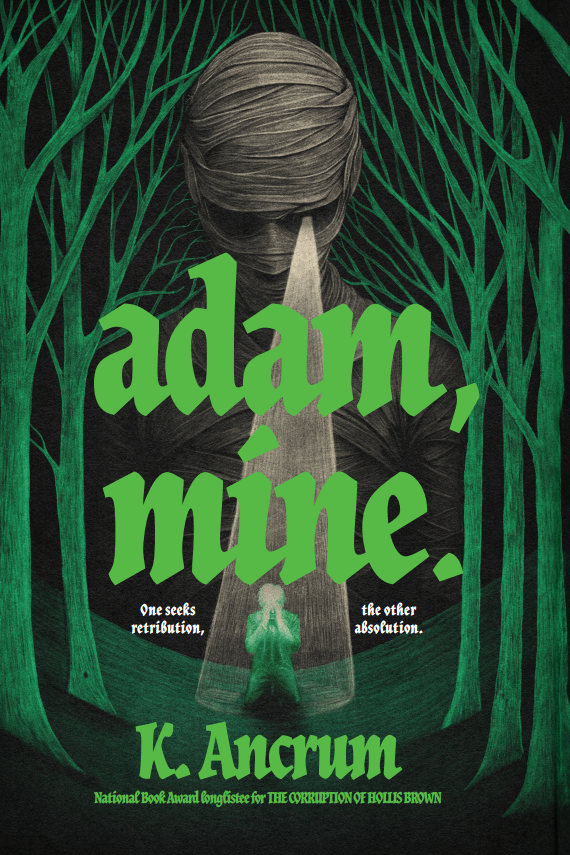
I always start with whatever concept I want to discuss or teach, do research on the topic. Then, I build my characters and my world around what would best showcase those elements or themes. When I was pitching Adam Mine, this is what I sent the publisher.
Thematically, I’m focusing on:
- Loneliness
- What does it mean to be Human (Philosophically, Legally and Biologically, with insight from: The Human Condition (Arendt) What It Means to Be Human: The Case for the Body in Public Bioethics (O. Carter Snead) Behave: The Biology of Humans at Our Best and Worst (Robert M Sapolsky)?
- Irresponsibility and the ethics of making mistakes
- The father/son; God/creation dichotomy—so much as it can appropriately be portrayed within the constraints of YA.
- “Who is the Monster and Who is the Man” (yes that quote from Disney’s The Hunchback of Notre Dame)
- Monster/Beast dichotomy (monstrousness requiring malicious intent to harm and beastliness being the purveyor of incidental or survival-based harm)
- Biological/body horror
I know I’m preaching to the choir here, but Frankenstein is a philosophically dense text with a plot that mostly entails a lot of running and travel with the occasional exciting murder. The emotional impact of the original book with all of its grotesqueness, sorrow, longing, fear and violence, is so rich mostly for the intentionality of its fraught internal monologues and lengthy passionate speeches.
It also has core thematic features unlike several of the other classics interpreted in this series, which make it uniquely difficult to adapt for YA while retaining its major themes (ex, the concept of a teen potentially “making” another being hence the Vampire Concept nudge, and the ‘failed father, failed god, failure of humanity’ nature of Victor).
But I do believe the sterility and distance of my vignette format would carry so many of these themes with particular strength and really inspire readers to think between the blank spaces on the page and I would like to thank you for considering allowing me to use it.
A recurring theme throughout your body of work is the blurred line between devotion and destruction – especially in intense relationships. In Adam, Mine., how did you explore the tension between vengeance and mercy without simplifying either Victor or Elias into hero or villain?
I focused on Justice and Amendment! There are so many questions with variable answers once the crime has been committed. For The Monster: without replicating Victor’s actions, what could possibly be an eye for an eye in this scenario? What does justice mean to The Monster, culturally, and what does forgiveness? Do the two even relate to each other at all? If Violence is the answer, violence isn’t a limited action, it reverberates beyond the perpetrator and victim to witnesses, loved ones, etc. What then is The Monster responsible for after personal “justice” has been achieved? Or, what is there to do once all has been satisfied and the pain still remains? What is there to do when the only person who really understands you and your circumstances is someone you hate for reasonable reasons?
For Victor: He’s focused entirely on undoing what he did or outrunning his punishment until he’s forced to understand the weight of his crimes. Then his questions begin: In order to harm someone that deeply I had to approach him from the perspective of someone denying his humanity. Is that the kind of person I would like to be? Is my death an adequate exchange for the monstrous quantity of what has been taken from my victim? Do I deserve to be able to engage with science the same way after using it to commit a visceral crime against God and Man? What do I have that has value and how can I use that value for atonement? What can I possibly say to him if we ever meet that would justify him not slaughtering me on the spot. What kind of man is he? What kind of man am I?
Your novels consistently center queer characters within mythic or speculative frameworks, from Icarus to The Wicker King and now Adam, Mine.. How has your approach to queer storytelling evolved over the years, and what emotional or philosophical territory were you most interested in exploring with this book specifically?
It has changed as I’ve grown, but my ethos remains the same. I started out writing YA as a young adult myself. I was writing about my peers and our fears, hopes and desires, and it was lateral. Now I’m 35 and I’m writing to children about the lessons, hopes and dreams that I have for them. It’s a great wonder and responsibility to be able to write for children and to children in the mainstream. Particularly for someone like me, as marginalized as I am, it is an incredible gift. So I take it extremely seriously.
For Adam Mine, I wanted most to have a conversation about what it means to become a good adult and the answers I provided are: The ability to provide caretaking for the weak and for those to whom you are responsible, placing value in community and what we owe each other just out of proximity, choosing kindness whenever possible, and justice whenever necessary. Forgiveness as a virtue, but not a requirement. Honor towards one’s parents and the elders in the community. Feeling strong and brave enough to be open with your feelings. Prioritizing education. Being able to advocate for yourself in stressful situations or scenarios where your needs are not being met. Knowing how to cook and clean and take care of yourself and your environment. Sharing as a reflex instead of a burden. Having empathy for the pains and losses of others, even when they’re acting out. Being able to self soothe and find time and place for pleasure. Refusing to look down on others or participate in cruelty, even when it is easy or funny or people around you are treating it like a way to bond. Spending time to figure out who you are and then refusing to betray the honor you have constructed for yourself. Having the humility to apologize and the intelligence to know when to change your mind. Finding the strength to rebuild and give back to the world, whenever possible.
INTERVIEW: YA SH3LF