
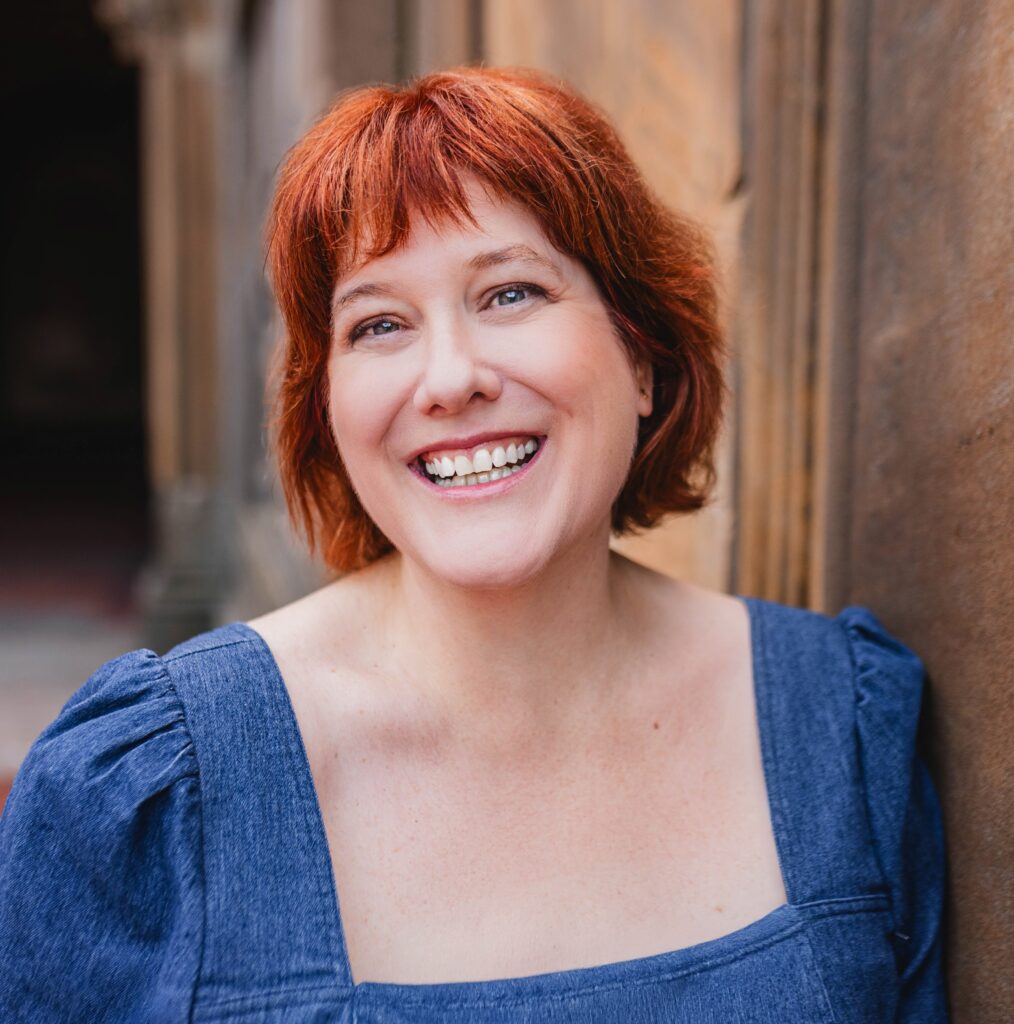
Gwenyth Reitz was born in Sri Lanka, and has since lived and worked in California, Washington, Alaska, Montana, Japan, and Mongolia. When not intrepidly exploring she writes genre-blending YA stories with swoony romance, mystery, humor, and heart. Gwenyth now lives in NYC with her husband and two kids, where she can often be found scribbling late into the night on her rooftop like the caffeine-obsessed night-owl she is.
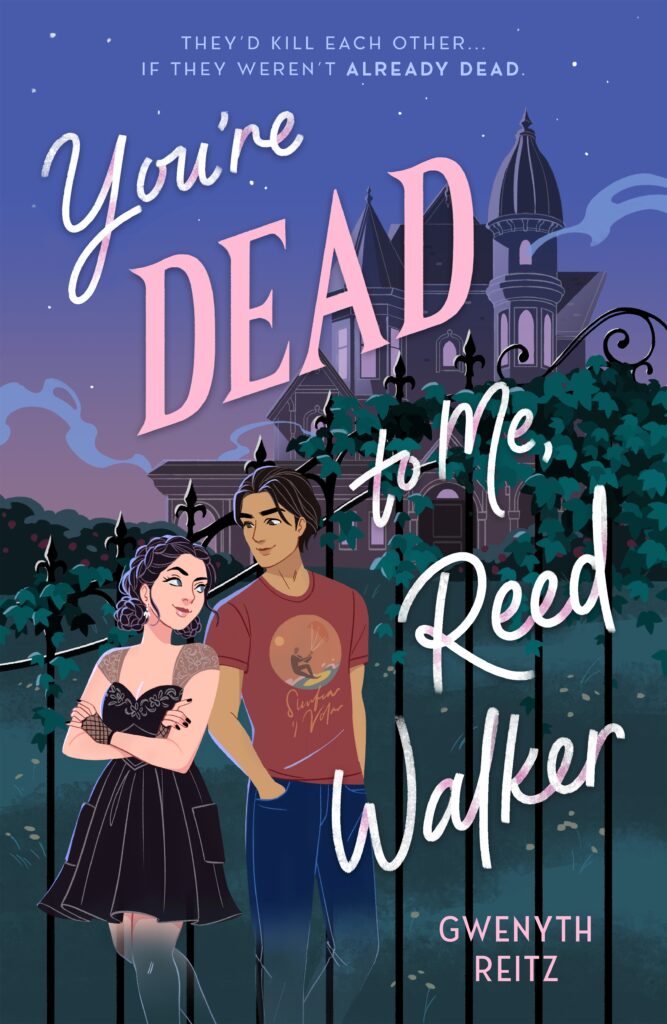
As a theater maker with an MFA in Interdisciplinary Art, Gwenyth works for Lincoln Center Theater teaching acting and directing teens. For fun, she likes to sing Hamilton karaoke, maybe not well, but with gusto. Her debut novel, YOU’RE DEAD TO ME, REED WALKER, comes out in the Spring of 2026 with Macmillan’s Roaring Brook Press, followed by the YA speculative romcom PROM ANOMALY in 2028.
You’re Dead to Me, Reed Walker combines a murder mystery, enemies-to-lovers romance, and a supernatural afterlife setting. What first inspired the idea of trapping two academic rivals as ghosts in the same haunted house and forcing them to solve their own deaths together?
I was always that odd kid who would have loved to spend the night in Disney’s Haunted Mansion. In 2021, I was struck with the idea of writing about a decrepit mansion where two teen academic rivals die at their high school graduation party, but rather than follow the living, I wanted to invert the typical ghost story and follow the dead. Inspired by both the reluctant ghosts and forced proximity of Beetlejuice and the academic rivalry of Never Have I Ever, I imagined how complicated it would be to haunt a house with your nemesis. And how this would be so much more challenging if he were both super-hot and disarmingly charming—when he wasn’t being a smug, entitled twit.
As for the genre-mash itself, there’s the adage to write what you want to read, and I found myself yearning for stories that similarly contained multitudes. First, I love books that center on a romantic relationship, especially when the dynamic can build slowly and authentically. But I’m also drawn to adventurous stories that cover a lot of plot. I’m less interested in romance for romance’s sake and more intrigued by people falling for each other while simultaneously having to puzzle their way through a challenge. I love reluctant allies who, when forced to team up, can slowly grow into so much more.
Tessa Sinclair is a driven overachiever, while Reed Walker is her equally ambitious academic rival. How did you approach crafting their rivalry so that it feels both believable and emotionally charged enough to evolve into romance?
Writing Tessa and Reed’s enemies-to-more rivalry was so much fun. To flesh it out, it helped to give them a shared history going back to the sixth grade. Tessa has spent the past years haunted by all the ways Reed has stolen her glory by constantly snatching up the first-place trophies at spelling bees and science fairs. Rivalries also thrive on misunderstandings, and so the characters enter the story with years of assumptions about one another. However, as their walls come down, they begin to see the real person standing in front of them rather than the story they’ve told themselves.
As Tessa learns how challenging one other can be a positive force, she says, “He raises the bar, but I raise it right back.” Ultimately, they’re able to reframe their rivalry, moving from pushing each other’s buttons to pushing each other to become the best versions of themselves.
The novel explores the unusual perspective of characters navigating the world as ghosts. What was your creative process for imagining how the afterlife works in this story—its rules, limitations, and the emotional experience of being “stuck” between life and death?
Figuring out the rules of the ghost world was a fascinating world-building challenge. I had to decide which tropes to embrace and which to subvert. Since the story uses a dual first-person POV, I needed the afterlife to feel visceral. After all, it’s hard to write a romance if your characters can’t touch. So, Tessa and Reed are solid to one another and able to sit on furniture. They still have the sensation of breathing or their hearts racing, even as they acknowledge this could merely be a habit that followed them into the afterlife. To feel their romantic tension as a reader, we need those physiological cues. But they don’t eat, they don’t sleep, and I just couldn’t bring myself to let them smell things because that felt too “of this world.”
Tessa and Reed also develop some classic ghostly abilities, like passing through walls, alongside a few unexpected powers I think will really surprise readers. No spoilers here, but those were quite fun to write. Ultimately, though, I didn’t want to magic them a way out of their problems. They have some abilities, but they also have some serious limitations. Learning to work within those boundaries—or uncovering ways to channel their skills in unforeseen ways—is a lot of the fun of the book.
Even though the book is humorous and romantic, it also deals with themes of grief, unresolved secrets, and confronting one’s own mortality. How did you balance the lighter rom-com tone with those deeper emotional elements?
As someone who has experienced grief, I wanted to explore the loss that both the living and the dead would feel in this situation. The story doesn’t shy away from the hard places, though there’s a light touch, with plenty of romance and humor to balance it out.
I think the trick is not to linger too long in any one direction. The characters feel things deeply, as they should, but they also have good senses of humor and can laugh at themselves. When thinking of the sequence of events, I tried to keep all the story threads moving between the mystery arc, the developing romance, and Tessa and Reed’s very real feelings about life moving on without them. I think this is helped by the fact that they are moving on, too. Their afterlife isn’t stasis. They’re growing, changing, finding love and each other, and ultimately feeling ready to tackle their next adventures.
You have a background in theater and storytelling and work with young performers through Lincoln Center Theater. Did your experience in theater influence the way you develop dialogue, pacing, or character chemistry in your writing?
I love this question, and the answer is unequivocally yes. I am the writer I am today because I’ve been working with storytelling for years, both as an educator and as a professional actor and director. As a theater director, I did a lot of new play development, partnering with playwrights as they workshopped new material, and those conversations around structure have been so useful to my own writing process.
I can also really hear the dialogue as I write: the pacing, the rhythm, and the intonations. It’s probably why I use a lot of italics and ellipsis, because I can hear those pauses and the emphasis so clearly. Sometimes, on a first pass, I write the scene as I would a play, line-by-line, and then fill in the world around them.
The theater has taught me a lot about nuance, too. Crying on stage is about trying not to cry; being drunk on stage is about trying desperately to stay upright rather than falling. One of the things I’ve learned from my years as an actor is that what’s unsaid is often just as important as what’s outwardly shared between characters. I like to think about the undercurrents running beneath a scene, such as the tensions, desires, and vulnerabilities that a character is trying to hide, and I trust my readers to pick up those signals. In a first-person POV, you also have the character’s inner monologue, which can run counter to what they say out loud.
As your debut novel, You’re Dead to Me, Reed Walker introduces readers to your style of genre-blending YA stories that mix romance, humor, and mystery. What did your writing and revision process look like while bringing this unique story to life?
When I originally conceived of and wrote You’re Dead to Me, Reed Walker it was a single POV story, told from Tessa’s point of view. When Macmillan bought the book, my incredible editors hopped on a call with me and asked how I’d feel about bringing Reed’s perspective into the mix. I thought it was an inspired choice and I’m so glad we made that decision. I’ve loved writing Reed’s chapters, but it was definitely a challenge. I thought I knew him through his dialogue and presence in Tessa’s chapters, but it was much harder to get into his head and understand him from the inside out. It was also an interesting puzzle to uncover which elements of the story should be told from his point of view. Some chapters flipped from hers to his, adjusted for his voice and inner monologue, but others were written from scratch.
In the end, I truly love both Tessa and Reed. Having the opportunity to more fully explore Reed’s psyche softened me to him and helped me better understand the walls he puts up to the world and why. Plus, there’s something thrilling about writing a romance when you get to linger in both their perspectives. You can share with the reader all those moments of miscommunication and misunderstanding and how deeply they yearn for each other.
The book does hold a lot, as you say: romance, mystery, rivalry, humor, paranormal adventures, and some big feelings. It’s my sincerest wish that readers find themselves both laughing and tearing up within these pages. But I especially hope they swoon over the fun, flirtatious banter between Tessa and Reed, two academic rivals turned ghostly roommates who now must navigate the most inconvenient feelings ever.
INTERVIEW: YA SH3LF