
F.T. Lukens is a New York Times bestselling author of YA speculative fiction includingthe novels Spell Bound, So This Is Ever After, Otherworldly, Love At Second Sight, and In Deeper Waters (2022 ALA Rainbow Booklist; Junior Library Guild Selection), as well as other science fiction and fantasy works. Their contemporary fantasy novel The Rules and Regulations for Mediating Myths & Magic was a 2017 Cybils Award finalist in YA Speculative Fiction and won the Bisexual Book Award for Speculative Fiction. F.T. resides in North Carolina with their spouse, three kids, three dogs, and three cats.

In The Last Best Quest Ever, Ellinore has risen to fame as the kingdom’s greatest quester – even though her victories are staged. What inspired you to write a story about a “fraudulent” hero, and what themes were you hoping to explore through her public persona versus her private struggles?
Honesty, the inspiration was that I just thought it would be funny. Once I started developing the characters and drafting the story, that’s when the themes of public persona versus private life began to take root in the narrative. Imposter syndrome is something that Ellinore struggles with and I feel that many creative individuals experience it at some point in their career. There is this sense that milestones and achievements are more about luck and timing than about hard work. People may hear about someone who is an ‘overnight success’ but what they don’t see are the hours and hours of time and work that has gone into developing skills or writing a novel or juggling more than one job. And I feel, personally, that sometimes it’s a struggle to maintain a balance between a public version of myself versus the private version. It’s a conversation that emerges every so often about authors, especially queer authors, about how much of ourselves are we supposed to or obligated to share with readers. For Ellinore, even though her wins are maybe not the most honest, she still had to possess hero skills and knowledge of the fantasy world to pull them off. She has to learn to give herself credit for the things she has accomplished and not rely so much on public perception to gauge her worth.
Family is a powerful motivator in the book, especially Ellinore’s desire to save her twin brother Zig’s life. How did you approach writing sibling dynamics and the tension between personal pride and familial loyalty in this adventure story?
Ellinore and Zig are in this transitional space in their relationship moving from being kid siblings to adult siblings. I think people sometimes forget that sibling relationships have to evolve just like any other relationship as people change and grow up and experience different things. Ellinore and Zig are still learning how to navigate being different people and having different lives and different goals and how that affects their relationship with each other. There is quite a bit of hurt and misunderstanding between them that has to be resolved for them to have a closer relationship moving forward. And for that to happen, both have to set aside some individual pride.
The story blends classic quest elements, mythical beasts, and an ensemble of quirky characters, including Ellinore’s rival-turned-companion Aven. What draws you to mixing romance, humor, and traditional fantasy quest tropes – and how do you keep those elements fresh and surprising for readers?
I always think that if I am having fun writing the novel then readers will have fun reading it. When developing a group of friends or quest group, I think about what kind of characters would challenge the protagonist and in what way. Aven challenges Ellinore because they are as good as a quester as she is, and Aven pushes her to have to be better. Farrah challenges Ellinore because she suddenly becomes a mentor and has to think about what skills and lessons she wants Farrah to take away from the journey. To keep fantasy tropes from becoming stale, I take what is expected from a certain trope and then try to change it in some way or come up with a different angle to approach the trope from or think about the unexpected consequences. I can’t do that all the time, but it’s fun when I can throw in something surprising or different.
Ellinore’s journey forces her to confront who she really wants to be – the celebrated fraud, the hero others need, or someone entirely new. How did you balance writing a story that’s both a high-stakes adventure and a deeper exploration of identity and self-discovery?
I balance it by having an amazing editor.
I have always had a good grasp on the adventure and romance pieces of a story. But something I’ve really had to work on is character development. It’s one of those skills that has become stronger over each novel and it’s because of the notes I received from my editor in the earlier works. So now, when plotting, I’m not just plotting the main storyline, but also the character beats and the subtle changes characters may go through over the course of the journey. I have to be really intentional about it.
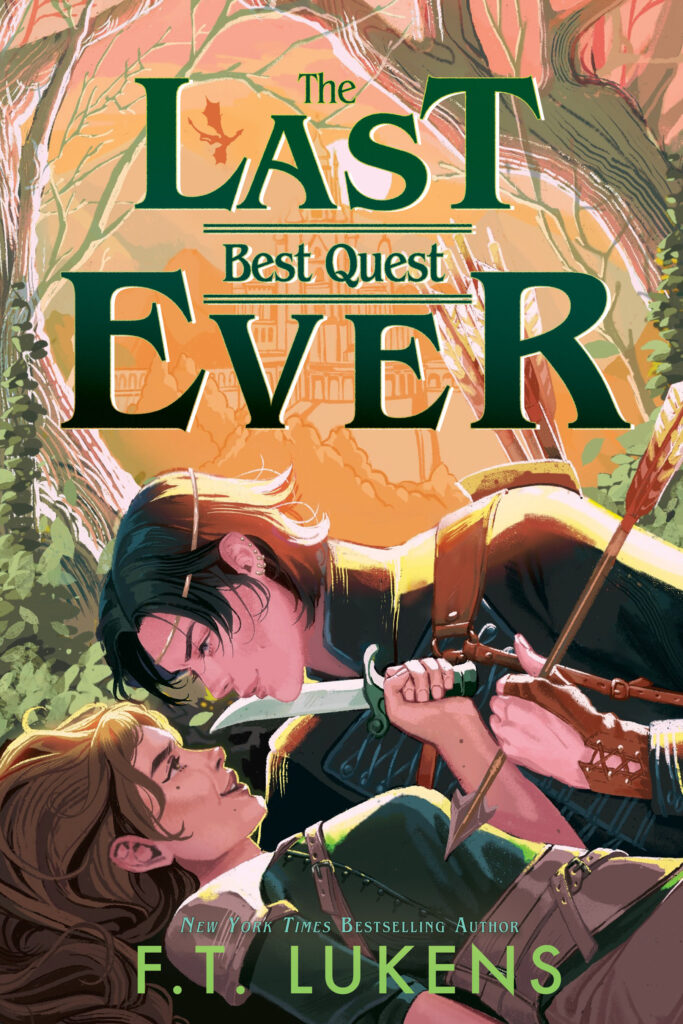
You are a New York Times bestselling author with a wide range of YA speculative fiction, from Spell Bound to In Deeper Waters. How did your past work inform your approach to The Last Best Quest Ever, and were there new creative challenges or freedoms you found in writing a cozy quest-romantasy?
With each book, I learn something new about writing or drafting or character development that I can then use when working on the next. I feel that this book is a spiritual predecessor to So This is Ever After. In that novel, the characters start at the end of the story, so the reader misses out on the whole quest leading up to that first chapter. This time, I wanted to write the actual quest. There was no fairytale or mythological base like In Deeper Waters or Otherworldly. And it’s not a contemporary fantasy, so it’s unlike Spell Bound and Love at Second Sight. The biggest creative challenge for me was that my last three books were all contemporary fantasy—based in a world like ours. I had to remember how to write a fantasy world where I couldn’t rely on modern technology like cell phones.
The world of The Last Best Quest Ever is full of mythical creatures, unusual allies, and magical trials. What was your process for building this world’s lore and rules – and were there specific myths, stories, or inspirations that particularly influenced your vision for this book?
So the world of The Last Best Quest Ever is a world that is in flux and experiencing an evolutionary stage where magical creatures are basically becoming extinct. There is a complex historical lore that the current inhabitants of the world have lost over time. I thought it would be a great challenge for Ellinore as a character to come across something that she has no knowledge of and no idea how to approach. But to do that and have magical creatures still very present in the book, I had to create a hierarchy. Creatures that were very powerful and ancient versus ones that are less powerful and newer in the evolution of the world. So the idea of having different levels of magical creatures came from needing a narrative device that would allow me to accomplish what I wanted character development wise. And when creating the Elder Beast, I didn’t want it to be something that readers would easily recognize either so they would have to learn along with Ellinore. I did a lot of research. I talked with a few of my friends who study folklore. And I based the Elder Beast on a creature called the Indrik—which is a myth from Russian folklore that is a relative of the unicorn. It fit the bill because it’s a chimera (like the manticore and griffin) and wasn’t a creature that most readers would be familiar with.
More about The Last Best Quest Ever HERE.
INTERVIEW: YA SH3LF