
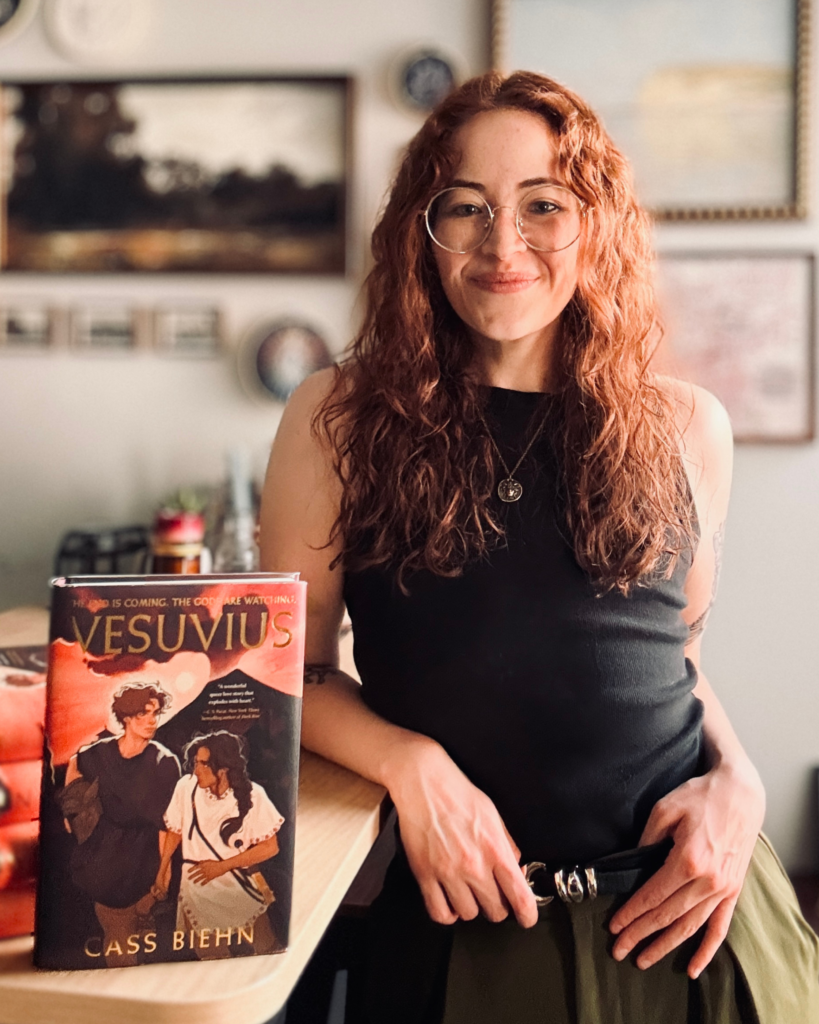
Cass Biehn (they/them) writes messy queer characters in messier situations—and always with angsty kissing. They hold a Master of Library Science from Aberystwyth University in Wales and currently live in the Utah desert, where they split their time between cosplaying and wrangling their dogs.
Cass’ debut novel, VESUVIUS, is out now from Peachtree Teen in the US and Atom Books/Little, Brown in the UK. The sequel, ICARUS FELL, is slated for release in 2027, with a standalone third novel THOUGH THIS BE MADNESS to follow in 2028.
Vesuvius places a queer love story at the heart of Pompeii during the days leading up to the famous eruption of Mount Vesuvius. What drew you to this particular historical moment, and how did you approach writing a romance in a setting where readers already know the tragic ending?
I arrived at Pompeii as a historical interest in a roundabout way, through being first and foremost a Titanic kid. My parents let me watch the 1997 film when I was just five years old, and I think it rewired my brain to naturally gravitate toward researching historical tragedies for the rest of my life. But what interests me about tragedies isn’t so much the tragic event itself; rather, it’s the broader story surrounding it. The lives disrupted in an instant, the futures lost and changed, the multitude of ways people react in face of unexpected (or expected!) tragedy. How do we frame these stories in the retelling? What do we forget or forgive in the aftermath? How do these events draw us together as a collective humanity?
In the excellent Broadway musical HADESTOWN, the character Hermes (who is also a prominent figure in VESUVIUS, via his Roman counterpart Mercury) captures the appeal of romantic tragedies best—
To know how it ends,
And still begin to sing it again
As if it might turn out this time To me, tragedies reflect an endless well of human hope. We know how it ends, but we revisit the story time and again in case a fresh telling reveals something new. It’s about looking at the darkest events of our history and seeking a thread of light.
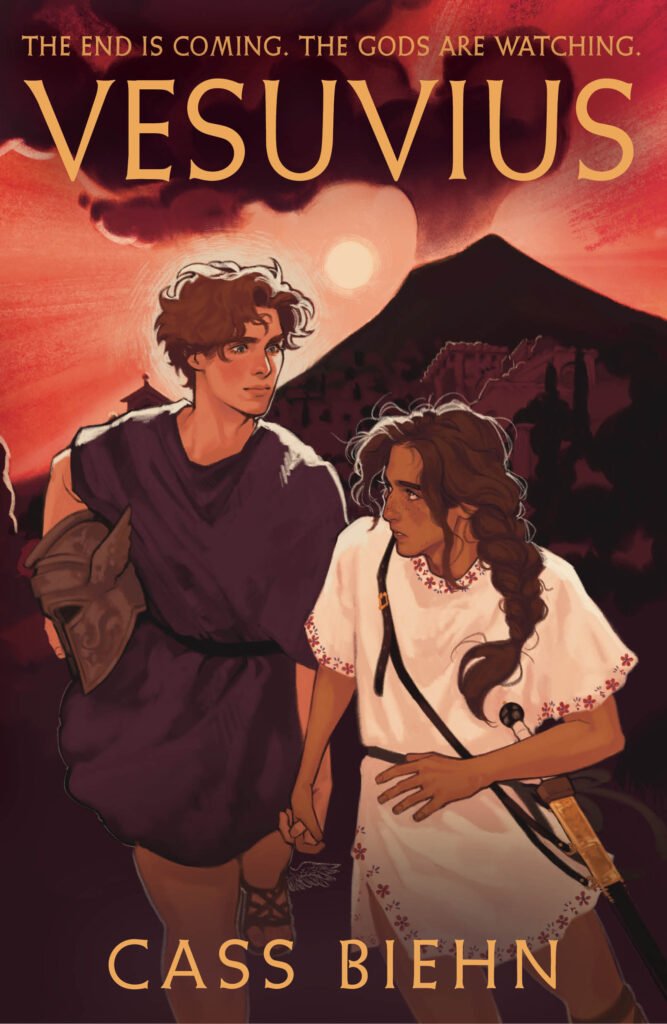
The novel follows Felix, a thief with a mysterious past, and Loren, a temple attendant haunted by prophetic visions. What inspired the dynamic between these two characters, and how did you develop their contrasting personalities and emotional arcs?
Felix is deeply irreverent—the gods have never helped him, so why does he owe them devotion? Loren is a temple attendant and aspiring oracle, but his station in society enables others to dismiss his visions, regardless of how accurate they are. Pairing a near non-believer in magic with someone incredibly devout seems like a match made in hell. But that’s exactly what drew me to writing these characters in this way.
When crafting dual point-of-view, every character should have their own goal, history, and arc—and the way these elements complement and contrast are fundamental to their growth. By giving Felix and Loren such conflicting worldviews, then forcing them to share space as they work toward a common goal, means they must learn from each other to succeed. This doesn’t mean they ultimately will see eye-to-eye. Instead, it allows for them to deepen their understanding of the world around them on their quest to self-actualize and grow, both as individuals and partners.
A key plot element is the stolen helmet of Mercury, a relic that carries both supernatural power and dangerous consequences. How did you approach weaving Roman mythology and magical elements into a historically grounded setting like Pompeii?
For Ancient Romans, the existence of gods and magic was a broadly accepted fact. This made plotting the fantastical elements of the book really fun—because belief was so intrinsic to daily life, it didn’t take much suspension of disbelief to allow these aspects to actually exist. Atheism as we define it didn’t really exist; the question was less about if the gods were real and instead about how close their proximity was to humans. I explore this debate in the book. Where some characters believe undoubtedly that gods can and do walk among mortals, others are more skeptical that gods have direct bearing on their lives.
But within the framework of presumed magical existence, I wanted to also examine the value of belief (in gods, in magic, in self) in a way that modern readers would relate to. Why do we worship? What does devotion entail, and to whom do we owe belief? Why are some drawn to comfort offered by religion, while others come to harm through it? Ultimately, this was the harder aspect of religion to unpack. Writing about godly helmets and curse tablets was easy, comparatively. Dissecting religious trauma was a bigger challenge.
You’ve mentioned that the idea for Vesuvius was sparked partly by the emotional chaos of 2020 and the feeling that the world itself was on the brink of disaster. How did those feelings shape the themes of destiny, survival, and hope within the novel?
A lot of authors still talk about their “pandemic books,” either as a project that lockdown enabled time for writing, or as a response to the global grief. VESUVIUS was both. I worked at a credit union during this time, where we had alternating weeks on and off to avoid the virus wiping out the entire branch at once. Without those off weeks, I would never have had time to write this book.
But VESUVIUS is defined by the frustration and helplessness that 2020 brought. Watching friends and family and strangers suffer, particularly those most vulnerable, while being able to do nothing except mask up, stay home, and wait… it felt like standing before a swallowing dark wave, one I could not control. So I turned to the historical tragedies I had always gravitated toward. Beyond tragedies, I turned to queer history as well. I came to realize how resilient our people have always been in the face of horribly oppressive times. And I began to research, which led me back to Pompeii, and Felix and Loren emerged.
Two queer kids facing down a literal swallowing dark wave, and doing everything they could to change their fates.
Your writing often focuses on “messy queer characters in messier situations.” When crafting Felix and Loren’s relationship, what was most important to you in portraying vulnerability, trauma, and healing within a historical fantasy context?
If there is one element I want readers to take from the book, it’s this: Trauma molds us, but it does not define us.
I want queer survivors to feel seen, more than anything. VESUVIUS explores complex themes of trauma, many of which were inspired by my own experiences. But we’re more than what others have done to us, more than choices made on our behalf, and more than mistakes we’ve made as messy, hurt people still trying to heal. I hope the book helps readers recognize that they deserve kindness, patience, and empathy. I have never set out to provide “perfect” representation, because that’s a myth that strips away every queer individual’s unique qualities. Intentionally carving space in my books for my characters to fall or flounder while healing is so vital and so human. Demonstrating grace and accountability for those mistakes is even more so.
Historical fantasy requires balancing research with imagination. Could you walk us through your writing process for Vesuvius—from researching ancient Pompeii to shaping the emotional and political tensions that drive the story?
I often joke that I love research so much that I got a degree specializing in the process of researching (Master of Library and Information Science!). Part of why I’m drawn to historical settings—Ancient Pompeii and Rome for VESUVIUS and its sequel, and Regency Edinburgh for my 2028 novel—is because it gives me an excuse to immerse myself in a new world, where I can peel away layers to explore what was different.
Or, more importantly, what’s the same as now. History is a living, breathing field, and discovering the ways humans have always colored their lives with meaning only adds to my rich appreciation of the world around me. I love history because I love people. I love that people have always been storytellers and artists, haters and lovers, complex and ever-changing.
Because of this, it comes as little surprise that although customs and practices might have been different in Pompeii, the heart of the characters was not dissimilar to what we value today. After I understood the contextual lens through which I needed to write, grasping what motivated the characters was not at all difficult. Many of the conflicts and tensions in VESUVIUS are parallel to our current times. It’s been incredible hearing from readers that they were able to relate to Felix and Loren, despite 2,000 years of separation.
INTERVIEW: YA SH3LF