
There are writers whose books tell stories, and then there are writers whose words quietly change the way we see ourselves and the world. Benjamin Alire Sáenz was one of those rare voices.
Poet, novelist, and recipient of numerous literary honors, Sáenz devoted his life to writing with extraordinary honesty, compassion, and grace. His work explored identity, family, love, loss, faith, and belonging with a tenderness that resonated across generations. For countless readers, his novels became more than stories – they became places of comfort, understanding, and hope.
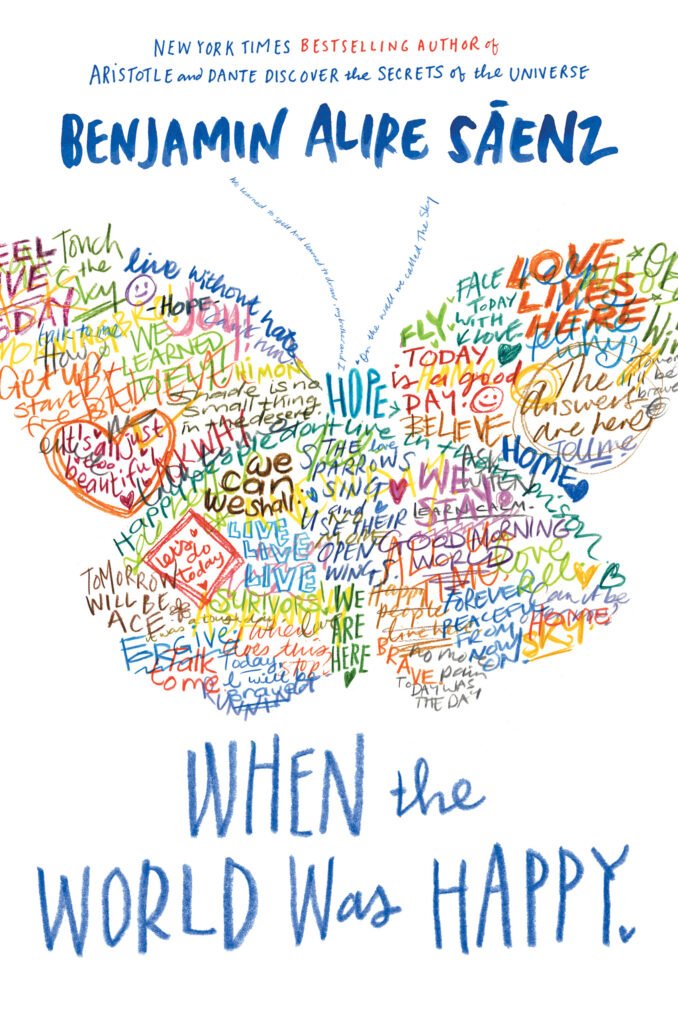
When we conducted this interview, it was intended to celebrate the publication of his new novel When the World Was Happy, arriving this September. None of us could have imagined that it would become one of the very last interviews he would ever give.
In the thoughtful answers that follow, Benjamin reflects on his latest work, the enduring power of literature, and the deeply human questions that have always been at the heart of his writing. Reading his words today feels especially meaningful – a final opportunity to hear the voice of a writer whose kindness, wisdom, and humanity will continue to live on through the stories he leaves behind.
It is with profound gratitude and deep sadness that we share this conversation in memory of Benjamin Alire Sáenz.

When the World Was Happy begins with an act of devastating violence that permanently alters the lives of CheChe, Emma, and their community. Yet even within that grief, the novel seems deeply invested in tenderness, humor, and human connection. What drew you to write not only about surviving trauma, but about preserving softness and love afterward?
There’s nothing like personal experience. When my niece was gunned down in a bowling alley in my hometown of Las Cruces, New Mexico, my family was devastated. You never get over it. But you can learn to survive and, if you are surrounded by the right people, you learn to love again—and when you do start loving again, you realize how profound love is and how salvation resides in the people who suffer alongside you. Love is a gift, and CheChe and Emma and their friends have to grow up fast, and they teach each other to love and to forgive and to cry and to laugh and to have fun again. And I think they also learn, through each other, that tomorrow is not a promise. Tomorrow, like love, is a gift. But most importantly, they fall in love with life again.
Throughout your body of work, El Paso is more than a setting – it feels like an emotional and spiritual landscape. In this novel, how did returning once again to the border shape the emotional truth of the story and the inner lives of these characters?
The border, for many, is a metaphor. Primarily, for me, it’s my home. There’s a river that runs through El Paso/Juarez and it is a poor river indeed. And that river runs through my heart. El Paso is a desert city and it has biblical implications for me. The desert is a holy place—it’s a place of encounter, a place where you meet your demons and your God. It is austere and lush all at once. The kids in this story are used to belonging to two countries without even being aware of it. Mexico is intimate and foreign at the same time. And their own country is intimate and foreign. They live at the edge of two countries which gives them the virtue of not being entitled. I’m a well-traveled man. I lived in Europe for four years. I spent a summer in Tanzania. I’ve traveled extensively in Mexico and Latin America. I learned to become a citizen of the world. And yet, I never felt I belonged anywhere but here. El Paso is my great passion. And my characters are like me—they’re border rats to the core.
CheChe’s journey after losing his leg is not framed solely through suffering, but through adaptation, intimacy, and rediscovering joy. As a writer, how did you approach portraying disability and healing in a way that resists reducing a character to tragedy?
I worked at the original Hospice outside of London for three months. Cicily Saunders said something I’ll never forget: “Pity is so close to hate.” Feeling sorry for someone is a kind of distancing. Empathy means being willing to enter, as much as we are able, into another person’s pain and sorrow. CheChe is a young man who has been deeply wounded—his life will never be the same. And yet he lets himself fall in love. It was lovely to write about the relationship between him and Placido—I hadn’t originally planned to include a love story, but the novel is all the richer for its presence. Sometimes, I surprise myself.
Your novels often carry the rhythm and emotional precision of poetry, even when telling deeply grounded contemporary stories. When writing When the World Was Happy, did the emotional architecture of the book emerge first through language, character voice, or image? What does your creative process look like when building such emotionally resonant prose?
I always start my novels on the sentence level. When I start to write I already know my story in a very broad sense. I write the novel in my head, and I mull it over and I’m lost in it before I ever sit in front of the computer. Some people would call this pre-writing. I find that to be an inaccurate way of describing what I’m doing. I’m writing! And when I sit down to do the physical writing, I am trying to create the feel of the novel through my words. I listen to the words coming out of me. It is unbelievable how many times I write and rewrite the first page of my novel. I am really in love with how powerful and moving words are. Everything in a novel is presented to the reader through words. The image is given to the reader in words. The characters are known to us through the words they speak. If I write a sentence, however lovely, that doesn’t seem to be telling the truth—well, out it goes. A writer is charged with telling the truth. And that is not an easy task. Writing has made an honest man out of me.
One of the most moving aspects of your work is the way young people are allowed emotional depth, vulnerability, and philosophical interiority. What do you think literature can offer teenagers – particularly queer teenagers and young people carrying grief – that other forms of storytelling sometimes cannot?
Literature is the most accessible art form available to young people. And if you create the right environment, I think young people will gravitate to books. I find young people to be profoundly beautiful. They have an innocence they don’t even know they possess. And they tend to be rebellious which I find charming. I do think that young people think about important things. I also think they want to be good people. I think we’re too often judging their behavior instead of trying to discover what they think and feel. And the best way for young people to discover who they are is through novels and poetry. Especially young people who feel exiled because of their sexuality—they have a sensitivity and openness to literature.
This novel seems to ask whether happiness can still exist after unimaginable loss – not as innocence, but as something rebuilt through community, love, and memory. When readers finish When the World Was Happy, what conversations or emotional truths do you hope remain with them long after the final page?
I hope when my readers finish this novel that they go to the mirror and look at themselves and say: this is the face of love. And I hope they realize that there is nothing more important than the relationships they build with their friends. Fall in love with your friends. I think that’s what my novel is trying to say. We are unworthy of hate and revenge. We are worthy of love.
INTERVIEW: YA SH3LF
Read more about When the World Was Happy Here
© Please do not copy, reproduce, or republish any part of this conversation without prior written permission. Thank you for respecting the work and the integrity of this interview.