
Andy Darcy Theo is an author whose work is deeply shaped by his background in psychology and his experience in both clinical and educational settings. His understanding of human behaviour, mental health, and the complexities of the mind plays an important role in the stories he tells.
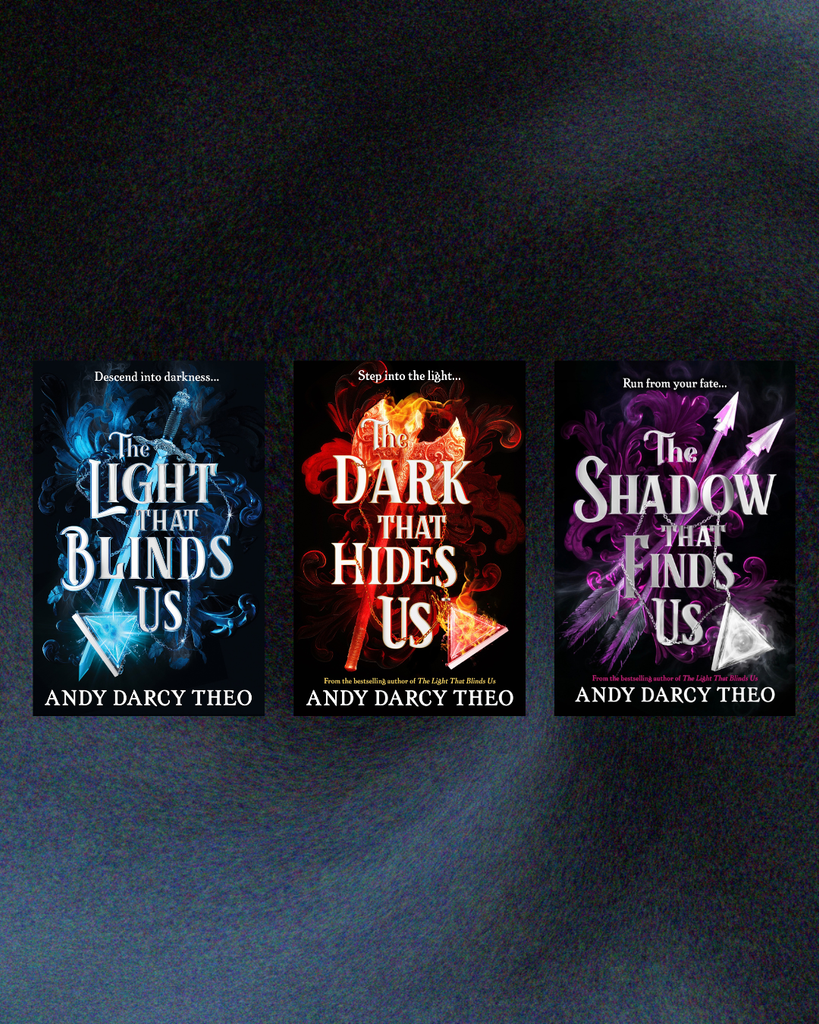
He first began writing his YA fantasy series at just 13 years old, and over the years that early idea developed into a much larger world. Since then, he has published three books, continuing to explore themes of identity, inner darkness, hope, self-discovery, and the search for light in difficult moments.
His writing combines fantasy with emotional depth, creating stories that are not only immersive, but also closely connected to real human experiences.

Across the Descent into Darkness trilogy, you’ve built a story that combines elemental magic and epic fantasy with deeply personal themes like mental health, identity, and found family. When you first conceived The Light That Blinds Us, did you already envision the emotional journey of the entire trilogy, or did the story evolve alongside the characters as you wrote?
From the very beginning, I knew the emotional journey I wanted to take the characters, and the readers, on my Descent into Darkness quartet. I set out to write a story of hope and perseverance, even during times of darkness. This has remained the same in all the years I’ve been drafting the books and during their publication too. However, the emotional journey of the specific characters has also evolved during each book, in which a new character shares the narration alongside Alexis. For example, in The Shadow That Finds Us, some of the chapters are from the perspective of Caeli, who has recently become disabled, and who is also beginning to explore her sexuality. The emotional journey she goes through regarding self-acceptance and grief evolved naturally when writing from her perspective.
Alexis’ struggle with the Shadow Man initially appears to be an external threat, but as the series progresses it becomes clear that darkness is also something deeply internal. What inspired you to explore the idea that our greatest battles often come from within, and how did you ensure those themes remained authentic throughout the trilogy?
The Shadow Man was actually inspired by the hallucinatory figure of a past patient of mine who had schizophrenia. She would experience the ‘Camouflage Man’ and totally believed him to be real, experiencing auditory, visual and tactile hallucinations of him. While I wanted a grand battle of light vs darkness, I also wanted to explore how sometimes, our greatest battles may be fought beneath the surface, invisible to others. I grounded Alexis’s experience of psychosis in my research, occupational background working in clinical psychology, and from personal anecdotes from family members who opened up about their own lived experience of psychosis to ensure representation of this was authentic throughout the series irrespective of any magical, external threat.
One of the series’ greatest strengths is the bond between Alexis, Demi, Blaise, and Caeli. Rather than relying on a single hero, you’ve created an ensemble where each character carries emotional weight. What is your process for developing a cast whose relationships feel just as important as the larger fantasy plot?
Love this question!! My favourite book trope in literature has always been the found-family trope, where the platonic friendships between characters is of central importance to the story. I wanted to make the characters diverse and feel real. Much of my inspiration for their personality traits came from research into the elemental zodiac signs. E.g. fire signs like Leo, Aries and Sagittarius, are described as being bold, confident and fiery, and thus informed Blaise’s character. I wanted readers to really resonate with the main characters’ friendships, so I worked on deepening their interactions to show how they support and complement one another one their respective journeys throughout the books.
The world of the Elementals grows increasingly complex with each installment, revealing new layers of mythology, moral ambiguity, and power. When writing a multi-book fantasy series, how do you balance long-term world-building with ensuring that each individual novel has its own satisfying emotional arc?
For me, I started with the big picture. I first thought of the series as a whole, then I went deeper into the three act structure of each individual book at a more granular level. By knowing what happens throughout the series, especially the big plot twist at the end of book 4, it allowed me to breadcrumb and foreshadow moments in earlier books that readers would likely skim over, but that upon re-reader will serve as Easter eggs and be so satisfying to see! Regarding ensuring each book has its own emotional arc, I think it helped that a new character is brought on to co-narrate alongside Alexis with each novel, allowing for me to fully explore that individual in a typical way a standalone book could. Each book can be read separately, but the enjoyment increases tenfold when read in sequence!
You’ve spoken openly about your own experiences with mental health, and those themes are woven naturally into the series rather than existing as a subplot. How did your personal experiences influence the way you approached Alexis’ emotional journey, and what responsibility do you feel when representing mental health in fantasy for young readers?
The most important thing in this whole series for me was to get right Alexis’s experience of his mental health difficulties. In media, I’ve often seen mental illness, particularly schizophrenia and depression, glamorised and sensationalised, and even romanticised too. I felt like it was my responsibility as someone who trained and worked in psychology to not trivialise his struggles. It wasn’t about Alexis representing every person’s experience of psychosis, but about showing what it’s like for one person, and how there is light at the end of the tunnel. With good intervention, a supportive network, and an unwillingness to give in, I hope Alexis inspires others to keep going.
As The Shadow That Finds Us brings the trilogy to its conclusion, looking back at the journey from The Light That Blinds Us to the final book, how has the experience changed you as a writer? What do you hope readers ultimately take away from this series – not just about light and darkness, but about resilience, friendship, and the parts of ourselves we’re often afraid to face?
The Shadow That Finds Us is not actually the last book in the series. The fourth and final book will be out next year, concluding the series in the most heart-breaking, earth-shattering way with Demi co-narrating the story (pun intended with earth being Demi’s powers!). Throughout the series, I feel like my writing has really developed, both in terms of prose but also storytelling. I hope from this series readers take away the power that comes from unity, the strength found in those with faith, and the bravery in those who have suffered. This is copied from the author’s note of the last book in the series (its title and cover reveal to be shared by the end of October): ‘Finally, what was most important to me to make clear when writing this series, was the message that you are the light. At times, you might feel like your light is flickering. It may change form, it may dim, it may be harder to see during chapters of your life. But you must never let it go out. As Incantus says, even if the light blinds us, there is no better way to live. So keep your light glowing bright, for you were destined to shine.’
INTERVIEW: YA SH3LF