
Ryan Douglass is a queer author and poet from Atlanta, Georgia. He is the New York Times bestselling author of the The Taking of Jake Livingston, which was an ALA Rainbow Booklist Pick and a Black Caucus American Library Association Best of the Best Booklist Pick. His sophomore novel, The Great Disillusionment of Nick and Jay, was a Junior Library Guild Gold Standard Selection and an Indie Next Pick.
Douglass’s work combines psychological depth with genre innovation, bringing underrepresented voices to the forefront of young adult fiction. He holds a BA in theatre from Hofstra University and lives in Atlanta with his dog.

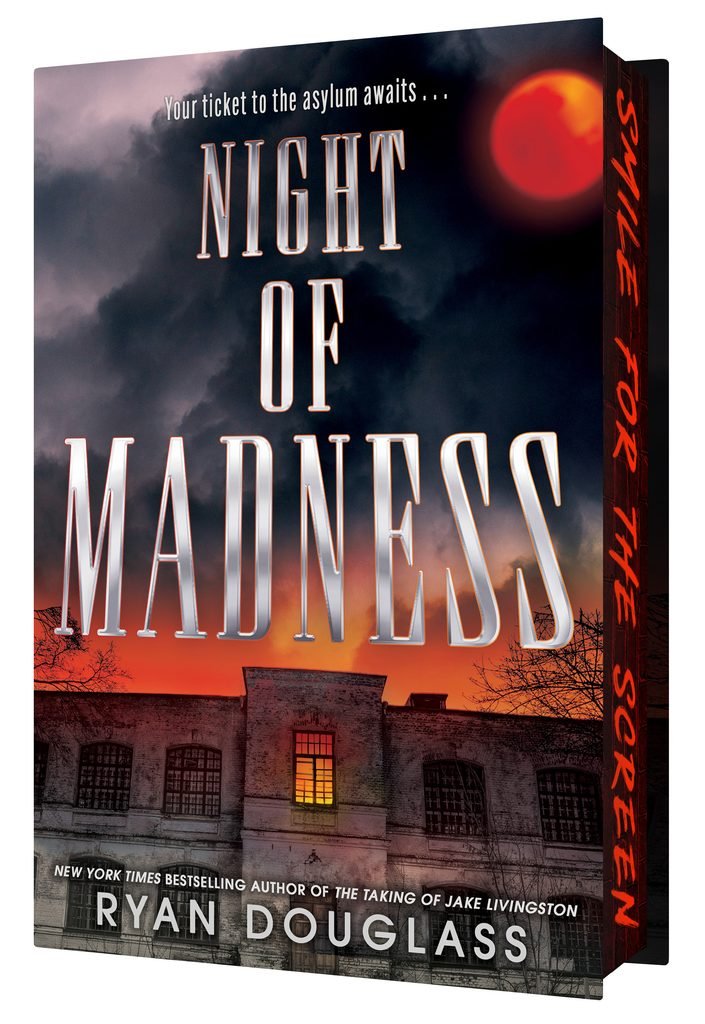
In Night of Madness, teen influencers compete in a horror-movie-themed overnight contest on the set of a classic slasher film, only to realize the real challenge is surviving the night. What inspired you to combine social media culture with the classic slasher-movie setup?
Pairing the slasher-movie set up with influencer culture felt natural because both spaces are about survival in their own ways. It allowed me to bring a modern lens to a familiar setup and explore the consequences of chasing relevancy in a high-stakes, tangible way. I’m always drawn to concepts that feel urgent but still classic and I think the combination of parts in this story achieves just that.
Mara’s connection to horror films comes from bonding with her father over the movies of fictional producer Jack Stanley. How did that personal element help shape Mara’s motivations and emotional journey throughout the story?
Mara carries a lot as the eldest daughter and a child of divorce. Her bond with her father who is now absent (and their shared connection to Stanley’s films) adds a personal layer to the competition. Mara’s journey through Jack’s game is somewhat tied to her journey to understanding her father’s exit, who left a hole in the family and lots of unanswered questions when he left.
The novel plays with familiar horror tropes—an isolated location, a group of contestants, and a sinister competition. How did you approach reinventing these classic genre elements so they feel fresh for modern YA readers?
I approached it mostly by being as specific as possible with setting and character motivation. Each character has their own reason for being there, but there’s this overarching interest they have in visibility, and the idea that attention can translate into opportunity. I wanted to explore the fears that are exacerbated by social media culture, which are ultimately fears of being invisible or unworthy. Those are timeless anxieties that are only amplified by the online ecosystem and what it rewards.
As the night progresses, Mara realizes the contestants are not there to win a game but to survive. What was your process for building tension and pacing so that the suspense escalates throughout the story?
There’s a sense of disorientation that comes with the experience. As they start the game, Mara is not immediately aware of what they’re being set up for, but she knows something is off. I think that sense that something isn’t quite right mixed with a lack of clarity on what that is creates suspense and a sense of dread that pulls Mara through the game and the reader through the story.
Your previous work, including The Taking of Jake Livingston, explores how young people confront hostile or dangerous worlds. How does Night of Madness continue or evolve those themes in a new direction?
Night of Madness still looks at young people navigating dangerous systems, but here the concept of being under a spotlight is a prominent theme. So, the story looks at the danger that comes with that, including what it’s like to absorb the opinions of strangers and how that can impact your sense of self. It also looks at what it feels like when you think you’ve been chosen for something exciting, when in reality you’re being used. That reflects a broader reality about how young people are exploited, often under the guise of being helped or supported by adults.
The story also touches on ambition, internet fame, and the lengths people might go to for recognition or money. What conversations or questions about modern online culture were you hoping readers would reflect on after finishing the book?
Mara’s journey is about realizing that external validation, like money, attention, and status, can offer temporary comfort but can’t fill deeper emotional gaps. Being visible doesn’t ultimately add up to much when she realizes her life is in danger, and it doesn’t fix her core problems. I want readers to reflect on how much of the hyper-visible lives we find alluring online can actually be empty at their core.
Read more about Night of Madness HERE
INTERVIEW: YA SH3LF