
Robbie Couch is the New York Times bestselling author of If I See You Again Tomorrow, in addition to Blaine for the Win, The Sky Blues, and Another First Chance. He is also the author of the novel Bloom for adults. Originally from small-town Michigan, Robbie now calls Los Angeles home.
In Just the Good Parts, Caspen discovers he can enter other people’s memories through candle scents tied to meaningful moments. What inspired this unique idea of memory-travel through scent, and how did you develop it into the central mechanism of the story?

I’d been itching to write a story that felt cozy and nostalgic, and I’m not sure there’s a setting out there more cozy and nostalgic than a candle shop in a small town in October. And with scent being so connected to our memories, for better or worse, I felt like candles were this natural way to tell a story that reveals itself to the reader by bringing the past back to life, bit by bit.
Caspen is searching for his missing father, even when everyone else has given up hope. How did you approach writing a mystery rooted in grief and love, and what emotional journey did you want readers to experience alongside him?
I didn’t want the story to read like a whodunit, of course, because Just the Good Parts doesn’t fall into a true-crime category. But to your point, the search for Caspen’s missing father is a core component of the plot, so I wanted to keep Caspen’s love for his dad at the emotional forefront, pushing the mystery forward, as opposed to throwing a growing list of criminal evidence at readers and hoping they’ll keep up. Fingers crossed that readers will feel as hungry for answers as Caspen was!
Throughout the story, Caspen repeatedly encounters a mysterious boy named Lars inside the memories he visits. What drew you to explore a romance that exists partly inside memories and blurred realities?
I had a lot of fun creating the world in which Caspen and Lars get to know each other! It was a delicate dance that I needed to approach carefully, as readers will understand after finishing the book, but I was really inspired by this idea of a romance blooming in this magical space that wasn’t entirely a memory or present-day real-life. And that’s all I can say before accidentally revealing a spoiler!
The novel plays with the idea that people often remember only “the good parts” of their past. How did this theme influence the way you wrote the story’s emotional arc and its exploration of truth versus nostalgia?
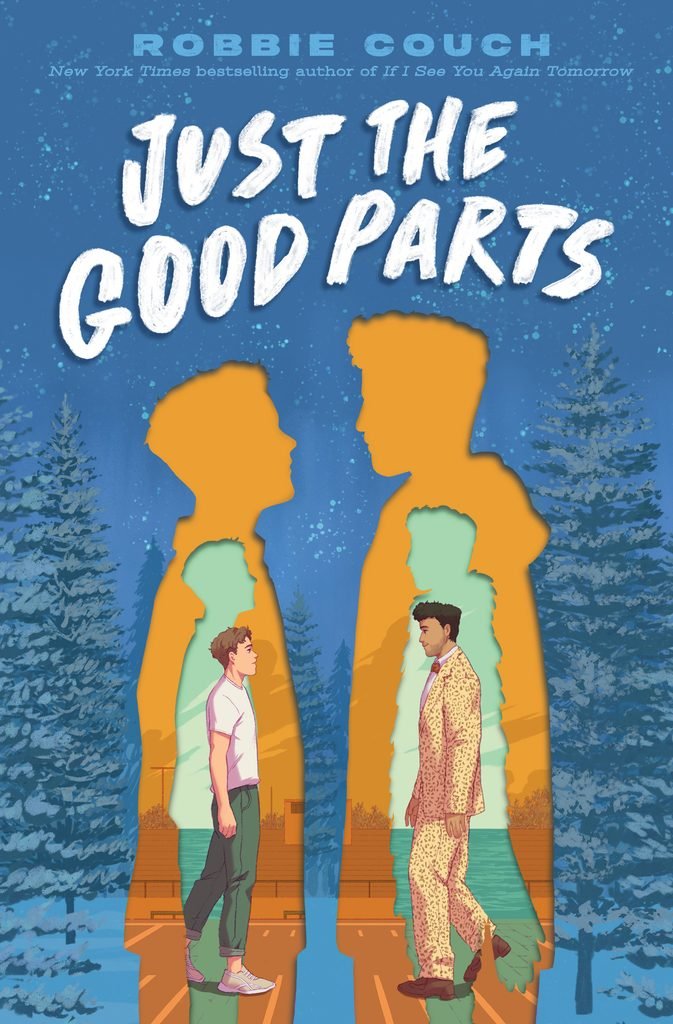
It’s definitely a theme that hits home. Just like Caspen, I’m a very nostalgic person, and I’ve had to reexamine how to think about the “good” and the “bad” that’s happened in my own life. As Caspen learns in the novel, categorizing our memories and experiences into an oversimplified binary means we’re missing out on half the story. I wanted Caspen to go on that journey of self-discovery, just like I did.
Your books often mix heartfelt queer romance with imaginative speculative elements, as seen in earlier works like If I See You Again Tomorrow. How did your experience writing previous YA stories shape your approach to this more memory-driven narrative?
It was tricky! Just the Good Parts messes with the reader’s sense of reality more than any other book I’ve written, which, to your point, is saying something when one of my previous novels was a time-loop romance. I think the biggest lesson I learned from writing my four previous YA novels—and especially those that leaned more speculative—is that I truly cannot over-prepare when plotting and outlining. You know the Charlie Day in Always Sunny meme where he’s crashing out over a conspiracy theory? That was me for six months.
As the lines between memory and reality blur for Caspen, the story raises questions about identity, perception, and the stories we tell ourselves. What conversations or reflections do you hope readers have after finishing Just the Good Parts?
I hope readers are challenged to rethink how they feel about their own memories and experiences. We can’t control what happens to us, as a therapist would probably say, but we can control how we respond. And finding the beauty within a heartbreak can be even more rewarding than celebrating an obvious win.
More about Just the Good Parts HERE
INTERVIEW: YA SH3LF