
Beck Kubrick has always had a particular talent for finding the funny side of the horrifying. A UK-based writer and cartoonist whose work blends comedy, horror, teenage angst and apocalyptic anxiety, they have built a distinctive voice across their comics, from their Kickstarter success Coby, Alone to Dead Girls: Beach Day, Meat4Burgers and the award-winning Don’t Worry, I Die at the End. Their work has also taken them to projects with Cartoon Network, Oni Press and Mad Cave Studios.
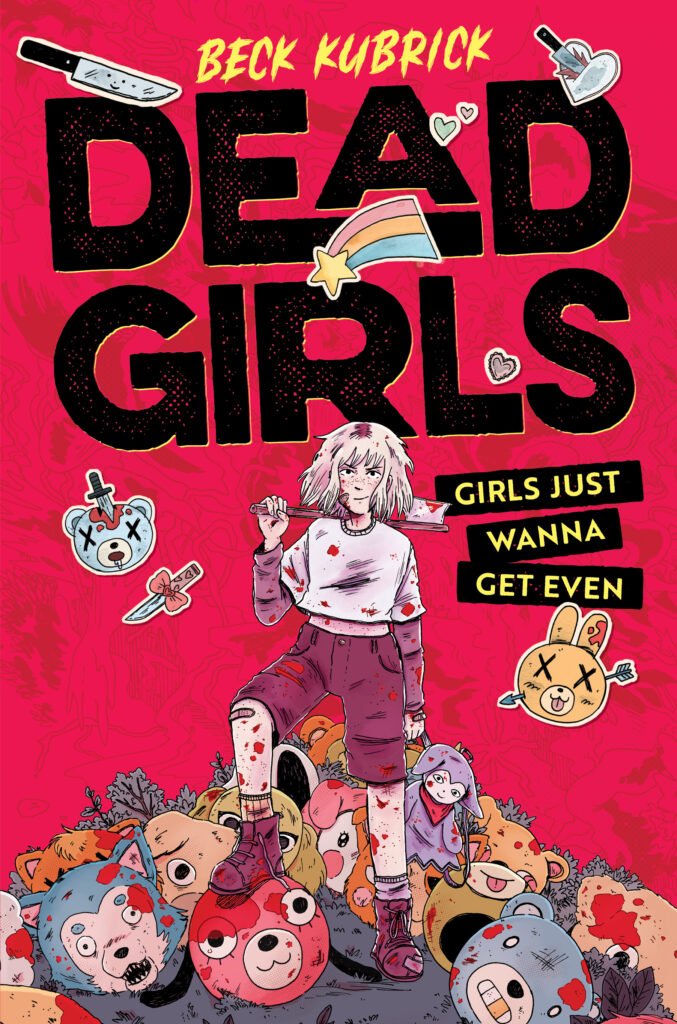
Now, Kubrick is bringing readers back to the world of Dead Girls with their debut graphic novel, Dead Girls. What began as a love letter to – and playful dismantling of – teen slasher movies has grown into a full-length story about friendship, murder and girls who are tired of being the ones who end up dead. In the book, Ash Hargreeves, the daughter of an infamous serial killer, finds herself at the centre of a series of copycat murders. Determined to prove their innocence, they and their friends decide to stop waiting for the killer to strike and take matters into their own hands.
With Dead Girls arriving this September, we spoke to Beck Kubrick about expanding the story from Beach Day into a graphic novel, their love of slasher films, writing “terrible girls,” playing with horror tropes, and what happens when the final girl decides they’ve had enough.
Dead Girls is described as a campy, feminist send-up of classic slasher films. What drew you to the slasher genre in the first place, and how did you approach both celebrating and subverting those familiar horror tropes?
I love horror, especially slashers, especially horror-comedy. There are rules and conventions, there’s a language to it. I learnt that language first from The Simpsons: Treehouse of Horror episodes, so my love was always based in parody. Then when I graduated to real horror films, everything was a little subversive and post-modern, playing with the tropes. Films like Tucker and Dale VS Evil (2010), Cabin in the Woods (2011), You’re Next (2011) blew my mind; they trusted the audience to know what to expect and still managed to provide a scare.
Horror mirrors our lives and society, Halloween (1978) is about a guy in a spraypainted William Shatner mask (yes, really) terrorizing a wealthy suburb, but it’s also about the death of the American Dream. Look around, life is weird! Society is weird! Horror gets that, it’s way easier to be scared of a guy in a hockey mask with a big knife than face all your vague, existential fears. Dead Girls is a love letter to horror tropes, but it’s also a ransom note- I’ve cut out all the pieces I wanted and pasted them to the paper. There’s also a magical unicorn called Dr. Almondbutter.
The story centers on Ash Hargreeves, the daughter of an infamous serial killer who becomes the main suspect in a string of copycat murders. What interested you about exploring a protagonist who is already viewed with suspicion by her entire town?
When I get asked about why I explore certain themes, I get a little self-conscious, it feels like an examination of myself more than anything, ha. I think a lot of us have felt like outsiders. Final girls often have a unique connection to the killer or killings. Nancy’s dad in Nightmare on Elm Street (1984) led the mob that (inadvertently) created Freddy Krueger. Ash has that via her mum, ‘sins of the mother’ and all that. I also just wanted Ash to feel like me, my friends, the feral girls I love in stories and any kid who doesn’t often see themselves in heroes and had never lived up to vague ideas of who they ‘should’ be. We’re all under a microscope. Ash is not a perfect final girl; she’s also not the perfect anti-final girl. She’s just herself, she’s messy, she can be wrong. Final girls are often pure, innocent, pretty (but not too pretty!), they can fight back only once they’ve been sufficiently traumatized. Ash doesn’t have this starting point; she has never been allowed to be innocent, but the same people that made her that way, hate her for it! A cornered dog will bite back, the child who is not embraced by the village will burn it down to feel its warmth. And good for them!
Friendship plays an important role in Ash’s journey as she teams up with her best friends to uncover the truth. How did you balance the darker elements of horror and murder with humor and the emotional core of teenage friendships?
Teenage friendships are so important, an important part of girlhood is messy, intense, blurry-around-the-edges friendships. I personally survived my teen years with shared gallows humor in sucky situations, never quite a serial killer though. I was like Ash, I didn’t have family in the conventional way and I didn’t want it. We all love the found family trope, but Ash is in a phase of rejecting it, based on the term ‘family’ alone, she views family as a cage. Being a teen is hard enough, you are adultified and infantilized, asked to exist in those two truths- especially girls. Ash isn’t fighting for herself, she can’t- she hasn’t learnt to love herself like that (yet!). She’s fighting for others, not self-preservation; she’s willing to die for her friends. Final girls are always alone, only one girl can survive, she’s not like the others, she deserves to live…why? Girls are too often pitted against each other, why can’t they work together? When you’re a teen, everything is more intense, messier; there’s blood and hormones and changing bodies – sounds like a horror film to me! I don’t know who would be better suited to laugh during the apocalypse than some disenfranchised teenage girls.
As both the writer and illustrator of the graphic novel, what does your creative process look like when developing a story like this? Do the characters and scenes start visually for you, or do they begin with the narrative?
I write and draw as separate practices too, but Dead Girls was always a comic; it always existed as words and pictures. I often come up with dialogue first. I drew some doodles of girls talking about horror tropes and how they interact with modern life; what pronouns should we use for the killer? How would the beginning of Scream (1996) work now? Who has a landline anymore? Phone calls are bad enough without a killer on the other end. Is a female serial killer a girlboss? It’s stupid but it is in the final book. I think I’d just watched Scott Pilgrim Takes Off (2023), that’s why Ash sort of has Ramona Flowers hair. I dove straight into drawing some pages, I immediately knew there was something here, more to say. I don’t know if I have true aphantasia, but I don’t really “think” in visuals, it sort of feels like a surprise when I draw, it’s fun. It also means I prefer to “write” with little sketches/thumbnails. It’s also a logistical thing, to plan how much can physically fit on the page.
You’ve said you enjoy stories about “terrible girls” and horror-comedy. How did those interests influence the tone of this book and the way you crafted Ash as a messy, unconventional heroine?
Humans have an innate desire for order and meaning in a universe that is meaningless and chaotic, it’s funny, as the existentialists say; “absurd.” Horror gets that, horror-comedy gets it even more. It’s funny and terrifying to be alive! Teenage girls get it too. They’re often done so dirty by society, often taught to live in fear, maybe it’s better to be the thing that’s feared? What girl hasn’t felt like a monster?
It’s not shocking that “sweet little girls” can get angry and can fight back, they’ve been doing that (in typically more covert ways) forever, in fiction and reality. I wanted to heighten it, Ash doesn’t fight because she has to, she runs towards the fight. She’s proactive, she’s not waiting to be backed into a corner. She’s ready to kill and good at it. She…kind of likes it. She wants revenge. It’s also a way to punish herself, because she doesn’t exist in a vacuum. Ash is messy, angry and brash, she’s not what she “should” be, she’s punished for it, but it’s to her advantage; not because she “acts like a boy” or rejects femininity, she’s just being herself. She’s punished for not being an innocent little girl by the same people that never let her be one, she’s grown through the pain into someone strong enough to fight back. She can be messy and wrong, she’s not a perfect victim, no one is or should have to be. One of my cover sketch ideas was rejected because “it looked like she is the killer” and I thought, “Well, she kind of is.”
This is your debut full graphic novel as both author and illustrator. What were the biggest challenges in bringing Dead Girls to life—from plotting the mystery to designing the visual style of the story?
Hayao Miyazaki said “I can feel it every day, the limit of my abilities.” I am no Miyazaki (I wish!) but you just want to get it right, to do a good job. How do you beam the ideas churning around in your head onto the page? With a big project like this, every thought and idea for months, or years, goes into it. The curtains are never just blue, even if it’s subconscious, even if it’s just because you ran out of red fabric. A finished project isn’t yours; you give it to the reader. People won’t like everything you make, cool, that’s fine…but I don’t want to be misunderstood! You can know the theory, the history, you can know a million facts about the thing; but you can’t think, or overthink, your way into a good book, a fun book that someone will want to read. You can’t tie yourself worth to your work, every editor’s note or review isn’t about you, writing is a job and a skill as much as it is anything romantic and vague. It’s embarrassing, but I think I just want a good grade and a gold star in everything – making a book, sending emails; just being a human being.
Read more about Dead Girls HERE
INTERVIEW: YA SH3LF