
Maria Ingrande Mora (they/she) is a queer, neurodivergent author whose work blends emotional depth with bold explorations of identity and resistance. Based in Florida, Mora writes character-driven young adult fiction that celebrates love, community, and self-discovery. Their books – including The Immeasurable Depth of You, Fragile Remedy, and the upcoming A Wild Radiance – highlight queer joy and complex, imperfect heroes learning to find their place in the world.
You’ve written across different forms (YA novels, graphic novels) and with strong queer representation. What about A Wild Radiance challenged you most as a writer compared to your previous work, and what new freedoms did you find in this book?
A Wild Radiance has a much stronger romance element than any of my previous stories. There’s a lot of freedom in leaning into all of the wonderful things that romance and love can encompass. I was delightfully challenged by mapping out a complicated polyamorous ship with different angles between the three characters, including a queerplatonic bond.
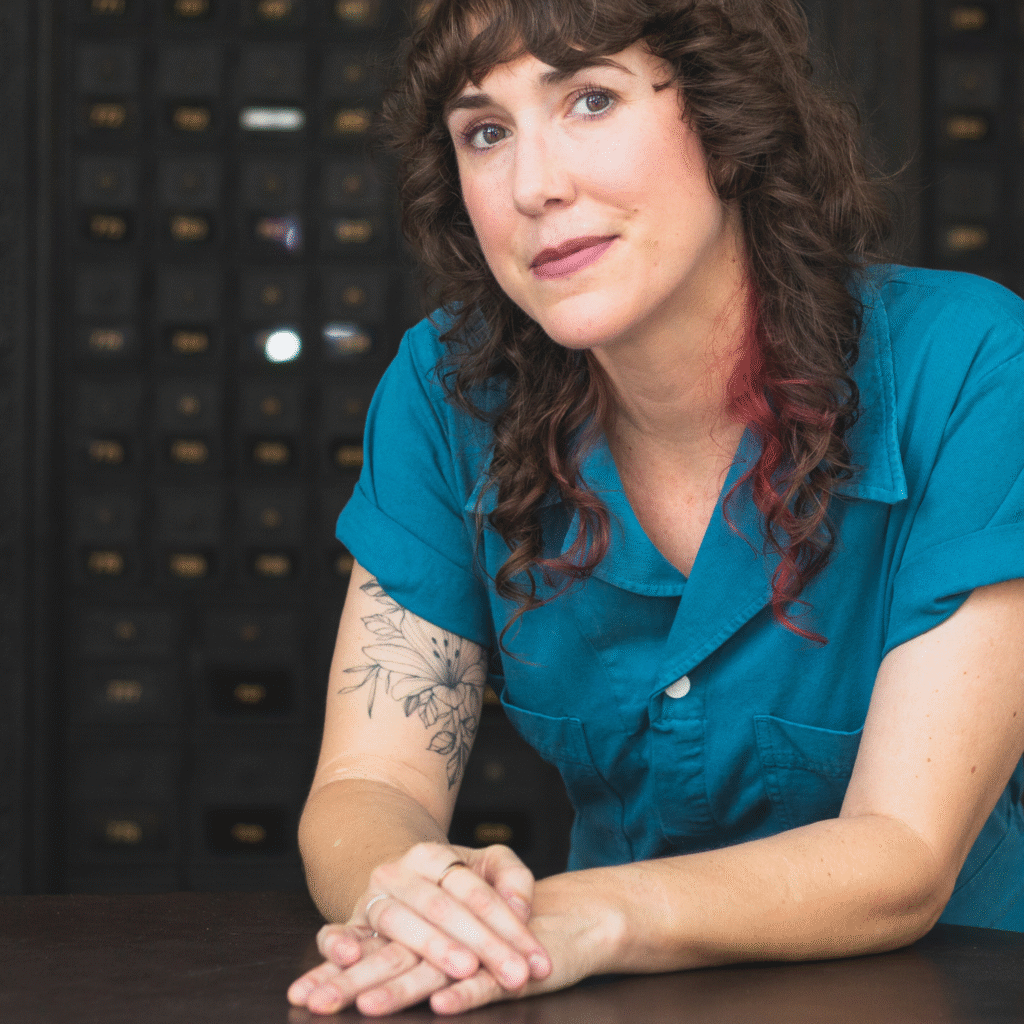
Photo Credit: Sandra Döhnert
From a craft perspective, this book challenged me the most in terms of the number of intense revisions. I was lucky to have the incredible editorial insights of Ashley Hearn, who shared my love for this trio and had an excellent vision for how to strengthen the last third of the book. I consider myself very strong at character work, but I can get a little lost in the weeds when it comes to plot, and that’s where I benefit the most from working in collaboration with an editor.
I loved the freedom of developing magic rules without being shackled to a very hard magic system. I’ll be the first to admit that my magic systems are more vibes-based than math-based.
When you begin a project like this, how do you move from world-building (e.g., magic systems, political structure) to character and plot? Can you walk us through your process – first draft, revision, research, voice work – especially working with a concept like “radiance” (magic tied to emotion and life force) in this book?
I bought a notebook at a bookstore in Denver and started sketching out the magic system for the story on the flight home. I had recently listened to Elton John’s song “Burn Down the Mission,” and I wanted to capture the way Bernie Taupin’s lyrics made me feel — as well as draw inspiration from the beautiful foothills of the Rocky Mountains.
I am a bit of a pantser to this day, and I often dive into a draft while simultaneously working on world-building in a notebook — jotting down rules and guardrails and character traits and names as they come to me. With this first draft, I gave myself permission to add a lot of placeholders (using “TK”) if I couldn’t immediately think of the name of a town or a side character. It’s actually very difficult for me to do that, so it felt like growth lol. You would not believe the amount of time I have spent sidetracked by going through baby name websites to try to name a character that’s probably mentioned one time ever.
I always write a first draft start to finish at pretty much near the final length of the book. My first revision pass after that is often the most difficult because it’s typically happening in a vacuum. During that pass, I often focus more on the prose than major plot beats. Once I’m revising with the input of my agent or an editor, it’s a different kind of challenge, but I don’t feel as if I’m floundering the way I do when I’m flying solo.
With this book, I did quite a bit of research (while drafting and revising) into early electrical systems, as well as the Chicago World’s Fair, which was a heavy inspiration for the Continental Exposition. Going on an architectural boat tour in Chicago was a particularly inspiring part of my research.
I am a very character-driven writer and get to know the characters either before or at the same time that I develop the world. I knew from the very start that this was going to be a story about resistance, and breaking free of harmful systems that could be considered allegorical to cults or oppressive religious communities or fanatical political movements like the alt-right.
My characters tend to appear in my imagination rather fully formed, so voice is rarely something that I consciously spend time planning or working on before I dive into a draft. However, voice is something that I then sharpen during revision passes.
As I mentioned above, I heavily revised this story, including wholesale rewriting the final 30,000 words or so. I can’t say that I had a great time doing that, especially doing it quickly, but I can say that I am beyond proud of where the work landed.
In your author bio you mention living with neurodivergence and chronic pain, and that vulnerability is important in your writing. How do you find your personal experiences shaping the voice, tone, or themes of your work – especially in a high-fantasy context like A Wild Radiance?
I seldom begin a project with any sense of trying to influence the characters with my own diagnoses or character traits, but I often find that I end up with commonalities with my characters. Josephine sort of erupted in my mind fully formed, and it wasn’t until I spent a little bit more time with her that it became clear to me that she was exhibiting traits of ADHD. With Julian, it was clear to me early on that were he to live in our times, he would likely be diagnosed with autism spectrum disorder. I feel very fortunate to have a neurodivergent brain and to be able to allow that lens to subconsciously and consciously weave neurodivergent traits into my stories and my beloved characters.
Self-acceptance is a very common theme in my work, and one that dovetails very naturally to me with living with any kind of disability. Josephine in particular has been suppressing so much about herself up until the story begins that it was a joy to allow her to expand into states of joy and rage and love. Authenticity feels so good! Even when it leads to messy behaviour. The real adventure in life is learning how to sit with all those facets of yourself and the people you love, with the understanding that all of us are going to be messy sometimes — and that we deserve to be.
When we look at some of the most beloved fantasy books that have shaped all of us as both readers and writers, there are plenty of characters who would be diagnosed with something or another. I often wonder if authors intended that or if that’s simply how the characters formed as they told the story. Personally, as both a writer and a reader, I love characters with explicit or implied disabilities having the same sorts of adventures that anyone else would have.
In A Wild Radiance, the protagonist Josephine is trained at the House of Industry, which teaches that wielding “radiance” comes with strict rules – especially the ban on forming attachments. What sparked your interest in exploring a system that insists on emotional suppression in order to harness magical power?
I just love the dynamics, and they feel relatable and universal. Emotional suppression is not unique to Josephine’s world. While I codified it in this story, I believe that young people are often either explicitly or implicitly encouraged to mask their true selves. As a late-diagnosed autistic person, and someone raised as a girl, I’m very sensitive to the ways that society and educational systems place unfair expectations on teens. I wanted it to be very clear that there was no genuine benefit in suppressing emotion — that it was, in fact, a way of controlling and manipulating people. At the beginning of the story, Josephine is rather unlikable. She is very much a product of indoctrination, and her internal dialogue can be quite painful. This gives her a long runway to grow, and to experience the innate pain of rearranging everything you know about yourself and the world around you.
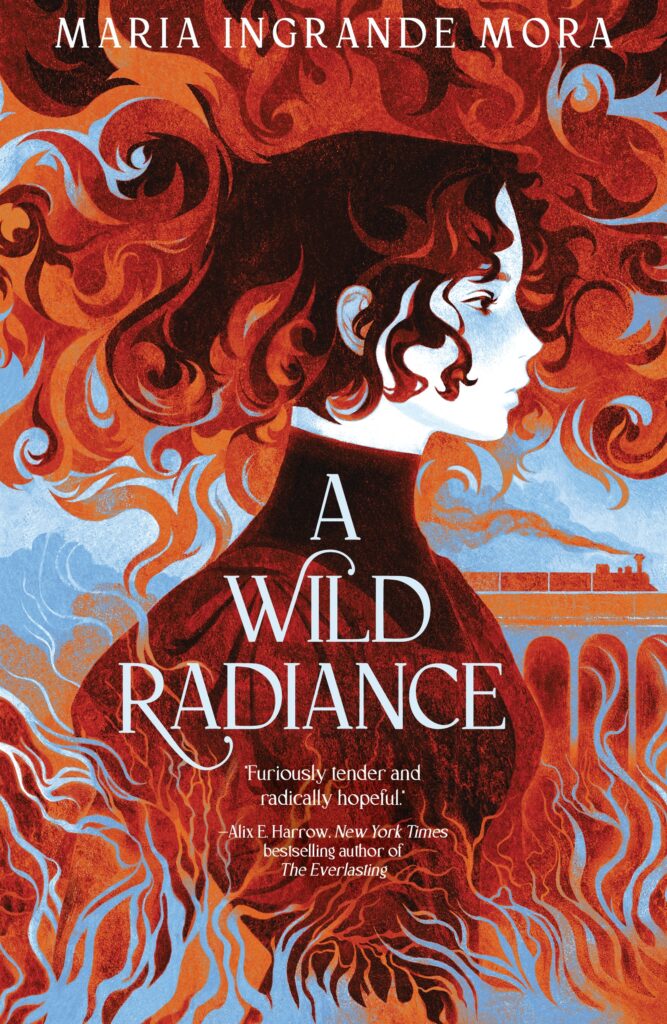
This is also a queer text in that Josephine has yet to embrace who she really is and find strength in both community and relationships that fall outside of the norms that she was raised to adhere to. In many ways, she is both an outsider and a conformist at the beginning of the story. I love playing with that tension. I was able to take it a step further by having her not only break the boundaries by forming attachments, but by experiencing love in a way that even our society right now considers atypical.
The blurb describes the setting as “a magical industrial revolution” and hints at class conflict, disease, and the march of Progress. How did you approach blending industrial-fantasy world-building (machines, power, magic) with intimate character arcs (desire, attachment, rebellion)?
This is such a tasty question! Industrial and political and social structures are very much tied to the ways that we move through the world on a personal level. We cannot grow or change outside of the context of the systems that influence the way we live. In A Wild Radiance, Josephine’s character arc is strongly tied to her growing understanding that she has been completely wrong about almost everything she believes. And her beliefs are strongly tied to the harmful systems that are exploiting everyone but the robber barons that control her society.
As a storyteller, I tend to focus more on interpersonal relationships at the end of the day than on the concept of teenagers saving the world. But this book comes the closest to young people driving change at a systemic level. At this moment in time, I think it’s important not to put the burden on young people to change the world, but to show them that their actions and the way they choose to love and live can make an impact on systemic injustice.
As a side note, I find there to be a strong correlation between technology and magic (this is not only due to the fact that I don’t really understand math or physics or any of the driving forces behind technology — therefore it all seems like sorcery to me anyway). Magic and technology both have the capacity to be exploited and exploitative. I believe that both magic and technology involve an equal amount of responsibility to consider impact, ethics, etc. I personally don’t see a strong difference between the concept of being able to sequence someone’s entire genome and doing a magic spell. And I hope that as a society, we never lose our sense of wonder when it comes to both emerging technologies and magic.
Young people today are growing up in the shadow of adults who are literally destroying the world that we live in with unfettered “innovation” and technology like AI that is being pushed at an exponential rate onto every facet of the way we live with very few checks or balances in place. In a way, this story is wish fulfilment: what if we had course-corrected much earlier on?
At the same time, it is really important to me to write books that are fun to read! By fun, I also mean that they might make you cry, but you will cry while not thinking about anything but the imaginative and distracting journey that you are on. While I tend to lean towards heavy themes, I want the emotional resonance of interpersonal relationships to have the biggest impact on the reader. And I want them to be transported.
The dynamic between Josephine, Julian, and Ezra seems central to the story. What role do relationships (romantic, platonic, or oppositional) play in Josephine’s journey, and how did you balance the action/revolution aspects with emotional stakes?
I think I probably answered a lot of this prematurely, but relationships are at the very center of Josephine’s journey. She is challenged by the people around her (like Ainsley and Ezra), she learns from the people around her, she learns about herself by noticing the way that she reacts to others.
She cannot be part of the revolution or any kind of systemic change without being consciously dialed into the way her actions impact others on a personal level. None of us can.
Her relationship with Gertrude in particular shines a light on how, at times, willfully obtuse she has been about the nature of her relationships with others. That relationship also gives both of those characters a chance to understand what forgiveness and redemption can look like on an intimate level and then take that growth and understanding and apply it on a broader level.
Also, I just think it’s cool that they kissed a lot. Back to queerness — it’s a very queer experience to have a friend who you experiment with and struggle to name your feelings for. I love those messy girls.
I believe that love in all its forms is the greatest strength that we have as humans to fight against injustice. The biggest challenge in terms of balance for this story was keeping it out of any sort of preachy territory despite how deeply corny I am about the power of love. It was important to me to allow space for the feeling of (and novelty of!) being sexually attracted to someone right alongside the incredible experience of platonic love.
Julian, Ezra, and Josephine are made more courageous (and reckless) by the love that they have for one another. I think that’s neat. And queer AF.
Walker Books – A Wild Radiance
Peachtree Books – A Wild Radiance
Interview: YA SH3LF