
Emma Jackson is an author who is passionate about storytelling in all its forms. After writing her first story at 8 years old for a school project, she couldn’t stop writing and penned dozens of stories with a pencil and loose sheets of notebook paper. Every story pushed her closer to her dream of becoming an author one day.
Emma studied professional writing at the University of Oklahoma, where she focused on growing her love of writing young adult fiction. She is a believer in the positive impact YA books can have on teens because of how powerful her favorite books were when she was that age! When Emma is not writing her next story, she can be found spending time with friends and family, playing cozy video games, going on adventures with her husband, or reading on the couch with her orange tabby cat.

Your story opens more than a year after the disappearance of Lawson from the secluded campus of Meddlehart Academy, and follows his brother Sutter’s quest. What inspired you to begin the novel after the disappearance – rather than at the moment of the event itself – and how did that choice shape the tone and pacing of the mystery?
I have always loved stories about siblings, and I really wanted to write a story that would let me explore the way Sutter’s life was impacted by an extended period of time experiencing his brother’s absence. By the time we meet Sutter, a lot of the people around him have insisted he should move on, but he refuses to give up on his brother. Sutter truly believes it’s down to him and his friends to find out what happened to Lawson. This is something that really shapes not only his character, but his decisions throughout the story and the way they drive the pacing forward.
The secret society, the Order of the Vipers, plays a major role in the story, with initiation rituals and buried treasure at its center. What appealed to you about the “dark academia” and secret society setting, and how did you balance the allure of the mystery with the dangers your characters face?
Dark academia is so mystifying. It almost feels like stepping into another world to read a dark academia book—a world that feels all its own while simultaneously being tucked inside the world we already know—and I loved finding a place like that in creating Meddlehart. I did my best to make sure that when things become dangerous for the characters, it always feels rooted in the setting of Meddlehart Academy and what would logically come out of that world.
Sutter and his friends gradually uncover clues and face escalating risk – you’ve described the risk of “initiation” as being “often greater than the reward.” What challenges did you face in plotting a story where the stakes keep shifting, and how did you ensure the characters felt authentic rather than just plot-devices in a thriller?
My characters are always a top priority for me when planning a story. As important as the plot is in any mystery, I can’t buy into what I’m writing if the characters don’t feel fleshed out to me. I spend a lot of time with the characters before I even begin drafting by plotting out their backgrounds, their goals, and their overall arcs in a separate document so I can feel confident in who they are from the very first page. I think keeping a solid grasp on each character’s personal goals can be a challenge when there’s a larger story playing out around them at the same time; for example, they’re putting themselves in danger to be initiates for the Order of the Vipers, but they’re also trying to navigate personal grief from their home lives, and they’re ALSO trying to sort out their romantic feelings. Finding the right timing for each emotional beat in between the movements of the central plot was tricky at times!
You studied writing with a focus on young adult fiction at the University of Oklahoma. How did your academic background and your broader reading habits influence the kind of YA voice you chose for A House of Vipers, and were there particular YA or mystery novels that you looked to as models while writing this one?
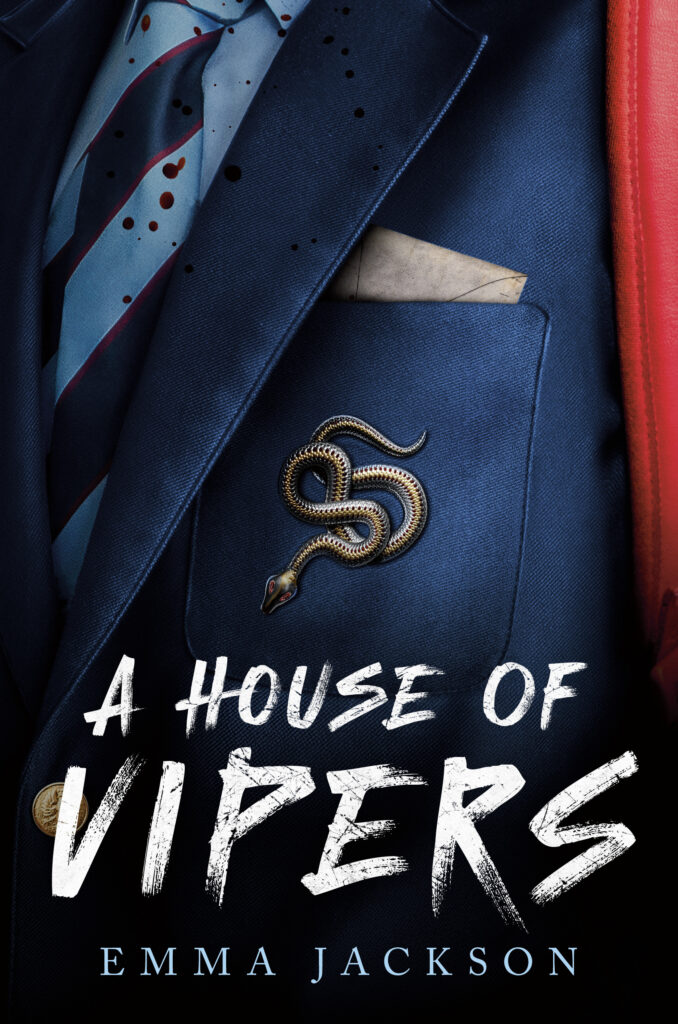
My academic background had a lot to do with the writer I’d become by the time I wrote the first draft of VIPERS. Before getting my writing degree, I wrote stories according to my own emotional and creative fluidity. One scene would follow the next because it felt right for the narrative in the moment, and I’d allow my stories to follow the paths that unfolded naturally before me! That’s not how I write anymore because I was required to focus on story structure and hitting the right beats with the right scenes at the right times in my projects for college courses. It really did have an impact on my creative process! I plot my stories much more thoroughly now before I begin writing, and I put a lot more emphasis on a fast-moving plot than I used to. Reading has also most certainly become a form of research. I do my best to read widely, but my heart is with YA and there are so many books that I’ve admired throughout the process of writing and editing my debut. TRULY DEVIOUS by Maureen Johnson is one of the comp titles I always use to pitch A HOUSE OF VIPERS because of its boarding school setting and intricate mystery, but I also love to compare it to SIX OF CROWS by Leigh Bardugo because of the found family element.
Many YA readers connect deeply with themes of belonging, identity, and risk – here, the boarding school environment, the missing sibling, and the secret society all tap into those motifs. What do you hope your readers will take away from A House of Vipers in terms of friendship, trust, and the question of how far someone will go to find the truth (or protect someone they love)?
I think Sutter’s journey absolutely demonstrates the two goals of protecting your loved ones and finding out the truth…and how the two may sometimes conflict. Sutter has to make some difficult choices as he chases after the truth about his brother’s disappearance, and he has to make these knowing that his friends are taking their own risks to help him. I am really excited to see how readers respond to it! Truthfully, though, my ultimate goal in every story I write is that it will bring joy to those who read it. I had a big move from one state to another as a teen, and that first year afterward was very lonely. It got better eventually, but during that time, I found that books made me feel much less alone. That’s all I can hope for—that readers will find a home at Meddlehart Academy with these characters!
INTERVIEW: YA SH3LF