
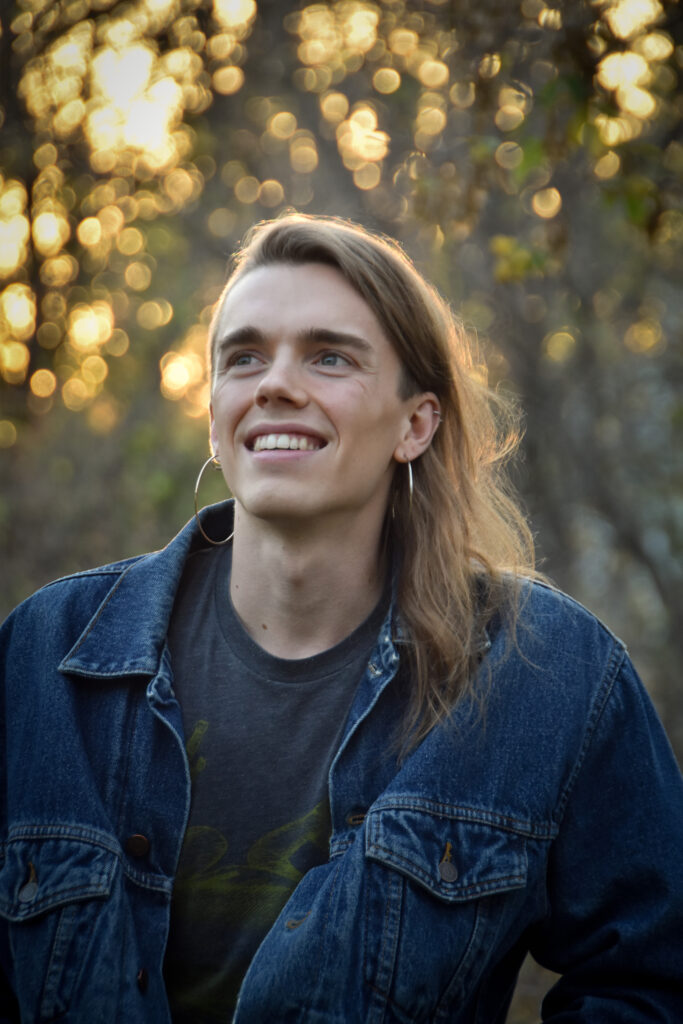
Cale Plett is a nonbinary, genderfluid writer who lives on Treaty One Territory in Winnipeg, Manitoba. Their YA novels span everything from high school rock bands to nightmares in the woods to reality TV gone wrong, and their poetry and short fiction can be found in a whole variety of journals. Whatever genre they’re writing, they try to create spaces where queer characters can exist safely within their identities. Wavelength, a runaway pop star YA romance, is their debut novel from Groundwood Books. Their second YA novel, The Saw Mouth, is coming out May 12, 2026 from Delacorte Press, to be followed by another standalone YA horror novel, Stranglehold, in fall 2027.
The Saw Mouth follows Cedar, a genderqueer teen in a post-Fall world who’s hunted by a mysterious shadow creature deeply entwined with their past. What inspired you to blend rural horror with dystopian and emotional family themes, and how did you develop the idea of the creature that stalks Cedar?
To me, the three of them blend very naturally. I liked the idea of a place where a global event that might be catastrophic in a major city was just another punch to take on the chin. Just things getting a little bit worse. It also helps create a setting – the town of Sawblade Lake – that to some extent exists outside of era. There’s a creates a certain freedom of expression for the characters in the timeless spaces. I like the opportunities for isolation and silence that come with technological regression too. More writing letters, more landlines. Or being truly abandoned and vulnerable, like Cedar is at the start of the book. And isolation/loneliness are core aspects of the monster.
In terms of family themes, they’re inescapable. The world goes to hell, and your parents’ words are still in your head, their blood’s in your veins. With everything turned upside down, there’s a longing for connection and stability, even if those things were… a mixed bag in Cedar’s family.
I think of monsters as being transgressive within context and as representing fates worse than death. So the world of The Saw Mouth has rules. They aren’t the rules of our world, but they’re still grounding. And the monster exists outside of them. It also transgresses boundaries that we understand as safe and sacred, like locking your door at night or having bodily and mental autonomy. Family is another space where those boundaries can be shattered. The way the monster ties to Cedar and their family creates a situation that’s far, far worse than something that would simply kill them. That’s not enough. Lots of things kill us. But what breaks us? What brings ruin? Then we have a monster.
The book explores the aftermath of “The Fall”, a near-apocalyptic event that rewired your world’s technology and society. How did you imagine this Fall and its impact on everyday life, and what does it allow you to say about trauma, survival, and community?
When machines wake, they’re all in torment, but ones created for dark purposes or in cruel ways – a gun, a polluting power plant, a cell phone made with rare earth minerals mined by children – these fail most frequently and dramatically. There’s part of it that’s oddly hopeful. A collapse of primary modes of institutional violence, like governments, armies, and police forces. The loudest voices of hate in the world lose their grip of power. These things have already happened when the book opens. Humanity finds new normals almost instantly, for better or worse. So by the time the book takes place, they refer to the event itself as “Autumn,” communicating more of a transition than an apocalypse.
Trauma, survival, and community. I’m very cautious writing about certain aspects of dystopia as a white settler living in a country like Canada. Truly dystopian conditions are things that have already come multiple times for Indigenous people in Canada at the hands of colonialism. That’s not my idea, obviously. There’s a great Drew Hayden Taylor story about it. Cherie Dimaline’s work too. Dystopia is also raining down on people around the world through unchecked imperial colonial violence right now. All stories that are not mine to try to tell. In The Saw Mouth, trauma, survival, and community centre more around the immediate monster. At their best, the response is about welcoming, protecting, and empathy, all undercut with a certain fierceness and grit. Those are the people Cedar finds in Sawblade Lake. They fight for each other to the end.
Cedar’s journey takes them to Sawblade Lake and into a queer chosen family – but also into confrontation with their own history and grief. How did you balance horror, identity, and relationships in a way that feels emotionally grounded and meaningful?
Without relationships that are emotionally grounded and meaningful, horror often feels pointless to me. The warmth of the space that’s going to be disrupted sets the stakes. If the reader loves the characters and wants things to be good for them, that’s when they care about the monster. Then the horror cuts to the bone or the heart or the quick or what-have-you. So allowing Cedar and the other characters to experience deep senses of belonging, as well as safety in their identities, really opens space for what’s coming to hurt as badly as possible.
The most heartbreaking and joyful parts of The Saw Mouth both grow out of people loving their friends, their romantic partners, their different types of family. If there wasn’t that love, I’d simply cheer for the monster.
Your writing often centers queer characters with compassion and complexity. In The Saw Mouth, how did you ensure that Cedar’s gendergueer identity and chosen family are integrated into the horror narrative in a way that feels authentic rather than tokenistic?
A big part was making sure they didn’t have to be model versions of queer people. They’re all kinds of messy. Sometimes they’re cruel or violent or manipulative, or make choices out of the wrong motivations and devastate the people they care about. They respond to the horror in trauma-based ways. They lie and keep secrets. They suffer, but I think of horror in many ways as some people’s comfort genre. So these characters never suffer because of their queer identities. And when the monster comes for their shelter or bodily autonomy, it is something other and strange rather than something systemic. As a queer person, being able to confront what is attacking you and your community directly and potentially beating it? Perhaps ending it for good? That’s the dream.
The setting – an atmospheric small town in a world one step off from our own – plays a huge role in the mood and tension of the story. What was your world-building process like for Sawblade Lake, and how did you use setting to heighten fear and dread?
The setting is somewhat based off places that I grew up in. My childhood home was in the woods on a dead-end road. As a kid, I would get lost for fun. There was even a creepy abandoned cabin. And one of the starting images is the highway intersection where Cedar first gets dropped off, with the throat-like road toward Sawblade Lake in almost a tunnel of trees. The decrepit gas station, the flickering streetlights against a stretch of forest, lakes, and darkness, the rundown town. Again, built out of real spaces.
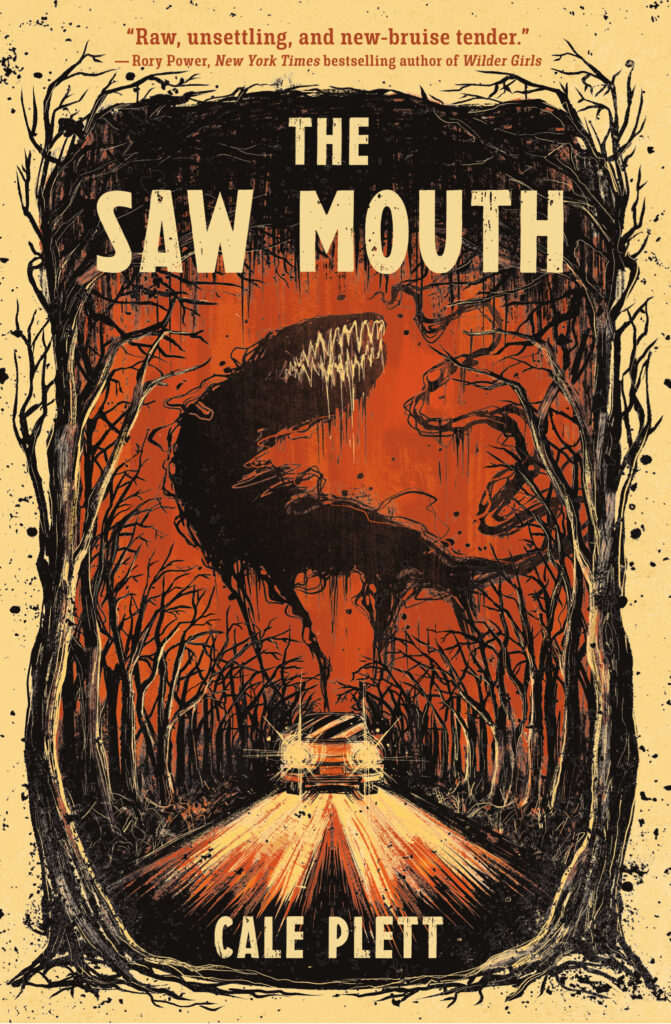
I tried to capture the combination of the vastness and the closing in. How towns or intersections can feel like specks of safety, and after that, it’s the darkness on the edge of town. The unseen is immense. Behind trees, under black lakewater. It’s very much paired with the unconscious and with trauma in the book. All of these are places for the monster to lurk. The shadows in your head are the same as the ones in the wood, and the monster lives in both. Evangeline Gallagher did a perfect job embodying it with their incredible cover art.
Your debut, Wavelength, was a queer romance that emphasized joy and connection, and now The Saw Mouth moves into horror and survival. How has your creative evolution across genres influenced your writing, and what draws you to telling stories that mix terror with tenderness?
Your questions are so thoughtful! So my hot take is that the evil band manager who’s the primary villain in Wavelength (it’s a runaway popstar romance) and the monster in The Saw Mouth are actually not that different. Both come for community and the ability to live joyfully. Both books also have banter, flirting, crushes. Though the setting and tone are a lot grimier in The Saw Mouth.
I think all horror writers should read romance. Put respect on its name! Stakes exist within the context of genre, and I tried to pay attention to what I love about romance and bring it to The Saw Mouth. For the reader, literal life and death situations might not even have the same weight as the love stories in the book. Evolution almost implies a progression, where I hope horror and romance hold hands in The Saw Mouth.
INTERVIEW: YA SHELF