
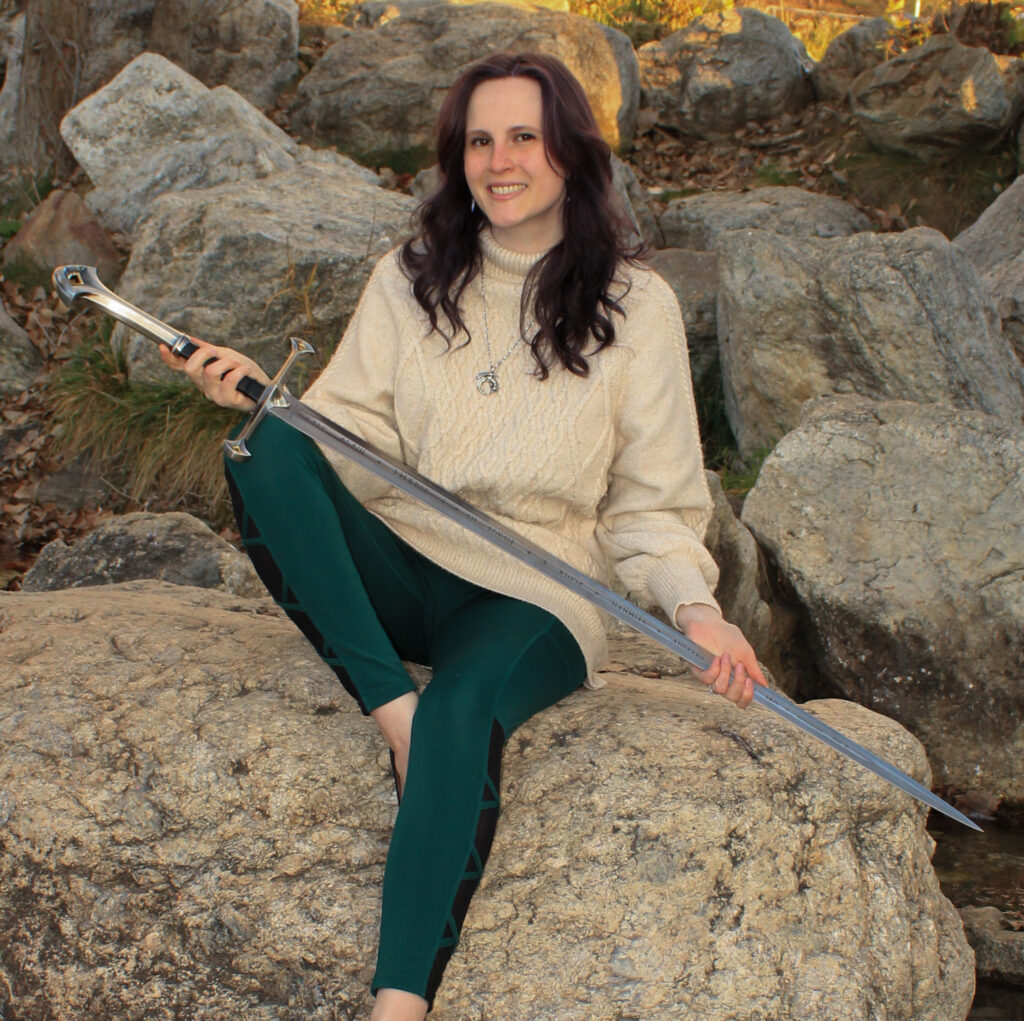
Ashley N. Y. Sheesley is a disabled author, scientist, animal lover, and a big fan of all things fantasy. In fact, she is only a scientist because she can’t figure out how to be a wizard in real life. When she’s not studying diseases or writing about dragons or werewolves, she loves to draw, paint, crochet, knit, spin wool, or venture out in the dead of night to Dark Sky zones and take photos of the stars. She lives with her husband and her small army of animals—a bearded dragon, two rabbits, and three cats.
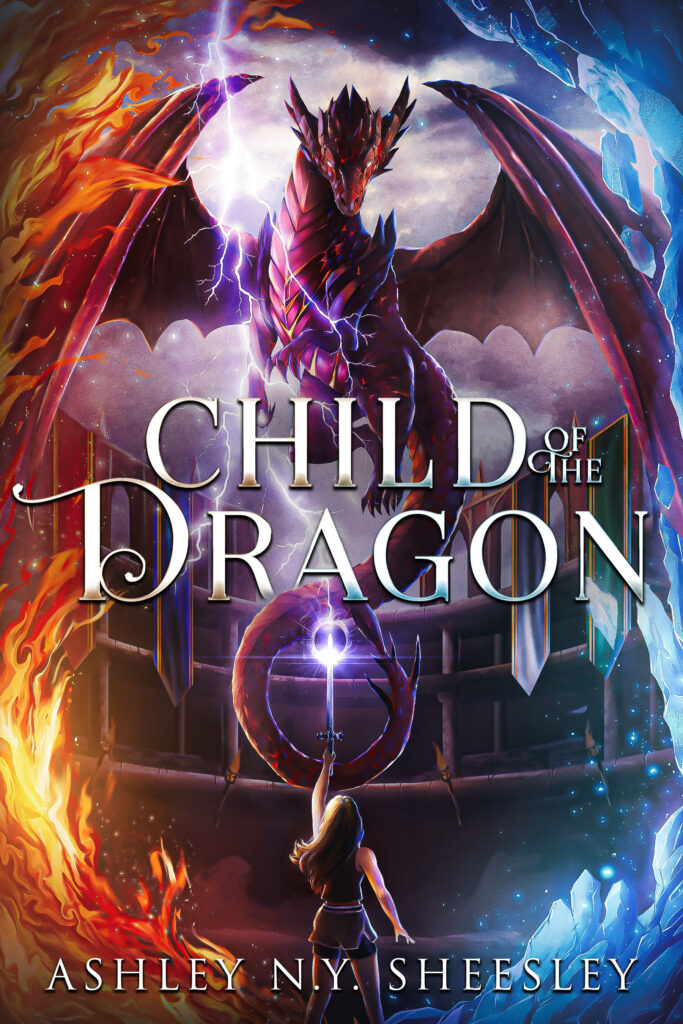
Her writing has been featured in Knee Brace Press, Artifice & Access: A Disability in Fantasy Anthology, and her debut YA contemporary fantasy, Child of the Dragon from Inked in Gray Press.
In Child of the Dragon, Kat discovers that the dragon stories her grandmother told were not only real, but a part of her identity. What inspired you to build a story where fantasy literally emerges from family storytelling and grief?
I initially came up with the earliest versions of this story over fifteen years ago when I was in high school myself, and I remember feeling this like “chased by dragons” levels of stress and wanting so desperately to have to have some fantastical legacy to achieve instead of all the normal high school stress—clubs, AP classes, friend drama, work, extracurriculars, performances, and (of course) calculus homework. I grew up with my grandparents and parents reading me books and telling me stories. I fell in love with reading on my own around eight years old, but stories were just so ingrained into my very being. I craved adventure! I checked the back of every closet for Narnia! I tried to see if maybe this time I had telekinesis or superpowers! At some point, all that yearning for fantasy turned into writing, and eventually turned into Child of the Dragon, and it felt only natural to have the initial stories in that come from a beloved family member.
The novel blends a contemporary setting—high school, friendships, everyday life—with shapeshifting dragons, ancient prophecy, and a global conflict. How did you approach balancing these grounded, relatable elements with expansive fantasy world-building?
I guess the benefit of coming back to the book you wrote in high school as an adult is that all those high school feelings were all ready in there, and the high school version of me wasn’t too concerned about whether or not dragons in the modern day seemed reasonable or not! So, the initial approach was “high school has too much stress, not enough dragons, what if I change that?” But of course, coming back to it later, there were a lot of logistics that I had to think through that the naïve enthusiasm of youth hadn’t considered. But what I think is just so fun about this is that I didn’t really have to do a lot of worldbuilding for the setting—most people can imagine an American high school from experience or the media! Which meant I could dive all in on the worldbuilding of the magic in a way that lets the readers learn about dragons, the curse, shifting, and using magic as the characters do! Mix that with some iconic high school things—homecoming, assemblies, sports, friend drama, crushes—and it created a world that I wanted to keep coming back to over the years, and I hope readers will feel the same way.
A central tension in the book is that Kat’s power is both a gift and a curse, tied to a larger system of control by tyrannical dragon kings. What drew you to explore that duality, and how did it shape Kat’s internal character arc?
One of the first lines I ever came up with for this book was something along the lines of “it used to be a gift, but now it’s a curse.” And I was just SO curious about how something that used to be rare, cherished, and sought after could be twisted and corrupted. I was really interested in this idea of agency and what happens when your ability to make decisions is just completely stripped away. So, I crafted a curse that tied the dragons to these evil kings—whenever they’re in their dragon forms, their kings can take over their bodies and force them to fight or kill or change someone else into a dragon shifter—while still having the foundation of the power be a gift. Kat’s lucky in that she’s free from the curse, but her friends are not, and in her POV chapters, you can see how beautiful being able to be a dragon is and how much injustice the other shifters have to face. In Coleman’s POV chapters, we get to see him struggle with the yearning to finally be free, to be able to finally take his dragon from without the risk of hurting someone else or himself, but instead, he’s forced to remain human for his own safety and the safety of the people he loves.
This duality really led to Kat’s building sense of rage at the injustice, and her desire to save her friends, while also kind of playing with this underlying fear of could she be cursed too? She knows innately how the magic should be and is desperate to make that real for her friends.
Your background as a scientist and your identity as a disabled author are both unique lenses. How have your personal experiences influenced your writing process, particularly in shaping themes like resilience, identity, and survival in Child of the Dragon?
You have no idea how many rabies references I had to cut from Child of the Dragon! And I’m only half joking lol. I have a background in animal science, virology, public health, and I now do data stuff for cancer research. But it means I put probably a little too much thought into dragon anatomy, healing magic, and, yes, whether or not a transmissible curse that takes over your mind was kind of like a less deadly version of rabies (it’s not…except when it is).
From a disability perspective, I wasn’t sick when I wrote this book the first time. Even for the first couple revisions, I was still healthy and able bodied. I knew Coleman was disabled, but he used to play a much smaller role—he wasn’t a POV character, and he didn’t really get a lot of screen time until the second half of the book—and I didn’t really explore the chronic illness aspect of his character. It was just a thing I personally knew about him as the author. It was a few months after I got sick that I had a friend offer me a developmental edit to help build her editing portfolio. She suggested I make Coleman a bigger character and give him a POV. I already had two POVs (Kat and Aaron), so I initially pushed back, but I realized how much depth he would add to the story having him be a third point of view. So, I sat down to write his character and knew I’d have to explore his chronic illness. This was before I was diagnosed and while I was still in that really early, really painful phase where I didn’t know what was wrong with me, and I was still really struggling to accept my new body. So, I wrote Coleman with my symptoms, but I wrote him from the future perspective I wanted to have about my disability—one where I had come to accept this was a part of myself and was much more comfortable navigating the world in a disabled body. I was able to explore my own grief and acceptance through him. I let him try mobility aids part time before I was willing to try them part time. I let Coleman accept himself as disabled and explore and learn his own limits as a way for me to be able to do the same, and I think that lent itself to really unique themes within his character arc and the story as a whole.
The story emphasizes found family, friendship, and hope in the face of an overwhelming curse. When writing ensemble dynamics, what is your process for developing relationships so they feel authentic and emotionally impactful?
I think it’s just in those little human things! How are they responding to stress? Who sings in the car? Who’s most likely to crack a joke at a bad time? What elements really bind them together? What keeps them coming back to each other after an argument? How do they show they care for each other? These characters are 100% ride or die for each other, and it’s kind of fun to explore how far they’ll actually go for each other.
From magic systems involving shapeshifting dragons to action-driven sequences and emotional stakes, the novel covers a wide range of tones. What does your drafting and revision process look like when weaving together action, humor, and deeper emotional themes?
It really does feel like weaving things together sometimes! With early drafts, I’m just trying to tell myself the story, and even if I know where the story will end up, I am still exploring the characters and the plot as I go. So, for me, revisions are where the magic really happens. It’s where I go back through and set up all the reveals, make sure the punchlines land, and try to make sure the emotions feel real. I learned along the way that with any sort of reveal—big or small—I need to make sure that the foreshadowing is sprinkled in there more than once. I had a lot of reveals that just weren’t landing right in earlier drafts, so I spent a lot of time trying to weave the relevant elements earlier in the story, and even for the little one line additions, it helped build up to some really amazing character moments that wouldn’t have happened otherwise and the reveals felt more like “ah! I should have seen that coming!” instead of “uhh, where did THAT come from?” With so many elements like you mentioned, it was really important to me that they felt cohesive, and I think braiding together all the pieces really came down to the gradual set up for a big pay off! I have a couple trusted writing friends that really help me figure out what’s working and what isn’t, and I wouldn’t be able to do this without their help.
INTERVIEW: YA SH3LF