
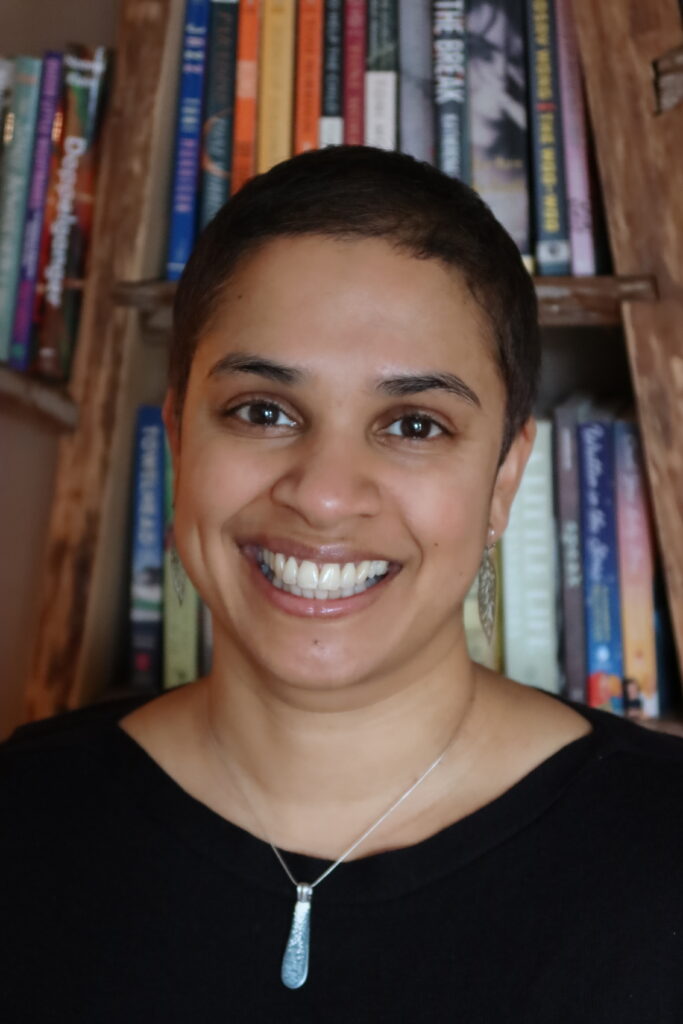
Tanya Boteju (she/her) is an English teacher and writer living on stolen territories of the Musqueam, Squamish, and Tsleil-Waututh First Nations (Vancouver, Canada). Her novel, Kings, Queens, and In-Betweens (Simon & Schuster, 2019), was named an Indie Top 10 Pick of the Summer by the American Booksellers Association and a Rainbow List selection for 2020. Her next YA novel, Bruised (Simon & Schuster, 2021), was selected as a Gold Standard book by the Junior Library Guild. Her latest YA novel, Messy Perfect (HarperCollins), is out in April 2025, along with a middle grade nonfiction book, Allyship As Action (Orca) in August 2025. Her latest book, Lake Life, will be published in May 2026 by HarperCollins.
When Tanya isn’t writing, she’s teaching and learning from brilliant high school students, riding her bike, drinking tea, reading good books, and trying to chill out at the cozy cabin her wife built for her. In both her teaching and writing, Tanya hopes she’s bending the universe even the tiniest bit toward justice.
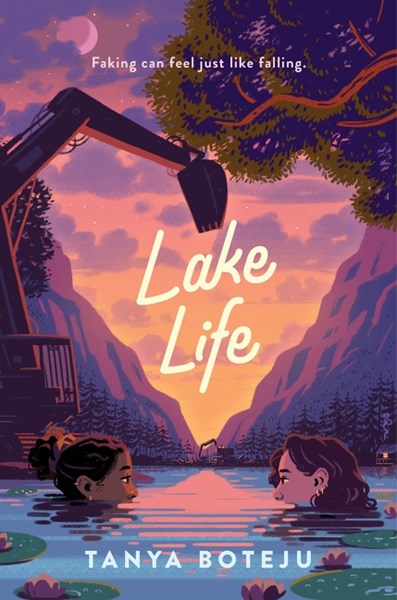
Lake Life brings together a fake-dating romance with deeper emotional threads of unrequited love and friendship rupture. What drew you to explore this particular emotional triangle, and how did you ensure it felt authentic rather than trope-driven?
Well, first I should say that I love a good trope if it’s not harmful to a particular community! And because this book is part rom-com, I didn’t entirely shy away from certain tropes – such as the spiky, self-protective character who slowly comes into community, or the two characters who are drawn to each other precisely for the traits that seem so contrasting to their own. But I also did enjoy the challenge of moving one character (Maya) from feeling in love with her best friend, to realizing that she also has feelings for another person, all in a very short time, which felt less ‘tropey’ to me. This particular challenge did require me to explore Maya’s confusing and complex feelings around what romance and love should and can look like, and also how childhood friendships can shift through different phases. Characterization is my priority when writing, so here, as with my other books, I spent a long time exploring Maya and Gabe’s characters – monologuing and freewriting beyond what made it into the book; and an added bonus was that Maya’s best friend and love interest Rashida started out as a point-of-view character, and I had done a lot of work with her as well, so hopefully she feels as fleshed out as the others, even though she’s no longer a POV character!
Both Maya and Gabe arrive in Spruce Lake carrying very different forms of resistance—Maya grappling with heartbreak, and Gabe rejecting the environment and expectations around her. How did you approach crafting two protagonists whose emotional arcs begin in opposition but gradually intersect?
I think opposition can be such an essential site for creation and connection. Sure, when we vibe with people who share our interests and passions, that can be exciting and fun and easy. But when we meet people who are different to us in fundamental ways–like how Maya wants the love and romance she’s witnessed her whole life and Gabe thinks “romance is for schmucks,” or how Maya is so connected to the land and nature, while Gabe is both irritated and fearful of it–I think this is where we’re pushed to change and evolve. Gabe’s discomfort with these new surroundings forces Maya to take on a more confident role than she’s ever had to, and Maya’s limited experience and view of love gives Gabe an opportunity to rise to an occasion where she actually needs to help another person. But they don’t gradually intersect in a vacuum with each other, either. I don’t think relationships work like that. They, like most humans, are also impacted by the people and places around them to bring them to new understandings about themselves and each other.
The setting of a small, “quirky” lake town is more than just a backdrop—it includes environmental activism, tight-knit community dynamics, and social pressure. What inspired this setting, and how did it shape the conflicts and growth within the story?
I love a good, offbeat, small town setting! My first novel, Kings, Queens, and In-Betweens was set against a fictional small town, too. The location in Lake Life was inspired by two things: one, the lake town my sister lives in, which is on Vancouver Island in British Columbia (BC); and two, the novel Fried Green Tomatoes (which makes a few appearances in Lake Life). Fried Green Tomatoes is what I call my “comfort book.” I love the cast of quirky characters, the small town setting, and the humour (though there are more serious themes as well) and I’ve read it numerous times. And I’ve spent a lot of time at my sister’s cabin on Shawnigan Lake. I really wanted to capture some of the close-knit community I feel in both the real setting and the setting in this comforting novel. But I also wanted to do justice to how important the land is–in general, but particularly in places like BC, where there is a long history of environmental activism and a strong influence of Indigenous stewardship and teaching about the land.
I wanted to keep the story light and playful, but it didn’t feel right to set the story in a place inspired by this land I live on without integrating some aspects of Indigeneity and activism. Many of the characters’ growth and changes in the story are guided or influenced by the town’s natural environment and activism.
Your work often centers queer teens navigating identity, relationships, and belonging. In Lake Life, how did you approach writing queer romance alongside themes of friendship, jealousy, and self-deception in a way that feels layered and honest?
The book isn’t about queerness in the same way that my last book, Messy Perfect, was–where queerness was central to the protagonist’s arc. In Lake Life, queerness is just the norm. As Maya says at one point, “Half the town is queer or gender queer or has been or will be, probably.” I love my own queerness, and I love queer stories–especially queer love stories! So it always feels very natural to me to write queer characters, whether they experience love or not. In this book, I wanted to include a lot of queerness, but the focus of the characters’ arcs is about how they see and experience love and community, period.
As both a longtime English teacher and author, you’ve spoken about how teaching informs your storytelling. How did your writing process for Lake Life evolve—particularly in shaping dialogue, pacing, and emotional realism for a YA audience?
I think my writing has definitely evolved over the course of each book I’ve written. My focus on characterization and emotionality have remained consistent–I always spend a lot of time exploring these. But my approaches to writing and revising have certainly expanded, both as a result of mentorship and teaching I’ve received, as well as the mentorship and teaching I’ve shared with others. Teaching and learning are sometimes indecipherable to me; many of my most valued teaching moments are when a student or mentee teaches me something, or pushes me to grow in some way. Additionally, spending so much time with teenagers helps me to understand what might be important to them, how they might handle certain conflicts, how they communicate with each other, etc (although there’s plenty of teen things I’ll never understand!). I hope that’s helped create emotional resonance with my younger audience. Something I think I’m still learning to maneuver is pacing–I’m a slow and steady kind of person, teacher, writer, and reader. Trying to balance my natural way of being with what some young people may want is a challenge I’m still working out! Lake Life may be my fastest paced book thus far, though.
Throughout the novel, characters confront the gap between what they think they want and what they actually need. When writing Lake Life, were you more driven by plot structure or by character psychology—and how did that influence your revision process?
As mentioned, I am almost always driven by character before all else. However, this was my first time publishing a book with alternating POVs. This posed a new opportunity and challenge for me to interact with structure in a way I hadn’t before because I had to think about how each character’s chapters moved the story forward (taking them from their wants to their needs) and also brought them closer together, which required me to consider how each character contributed to the other’s evolution toward their need. This can be tricky business! You really have to hold both characters in your mind almost the whole time. I have a lot of charts and maps and freewriting and brainstorming as a result. Lots of frustrating and confusing moments…but that’s the writing process for you. It’s not supposed to be easy, but gosh is it ever rewarding when you’ve allowed those messy moments to play out and things come together!
INTERVIEW: YA SH3LF