
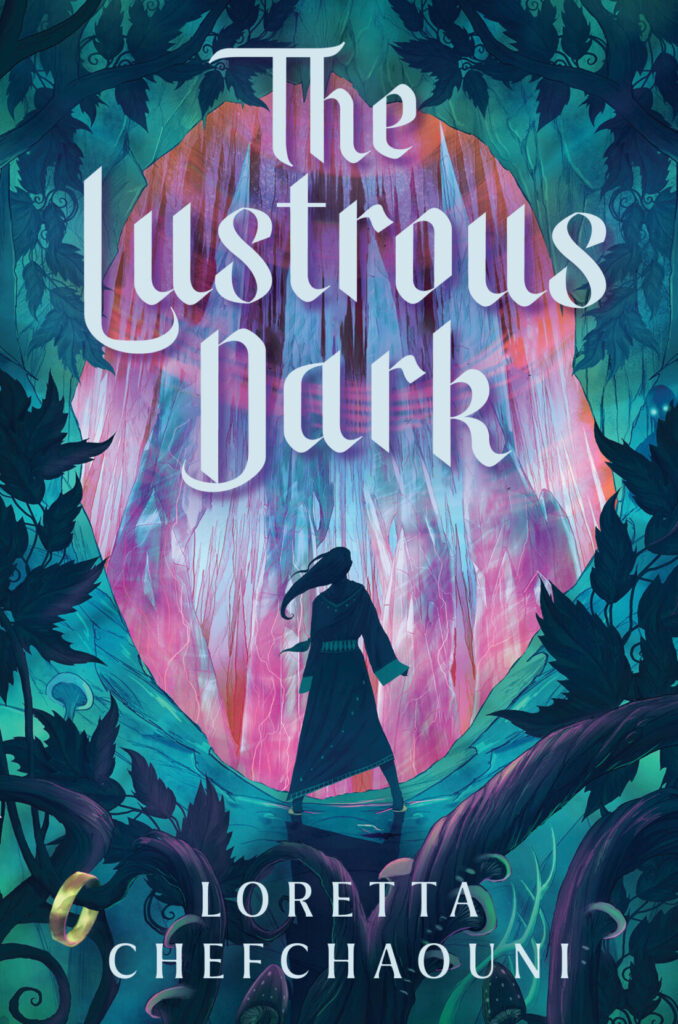
Loretta Chefchaouni is a former early childhood educator from Florida who writes for teens. Her fantastical tales turn grief and fear into myth and monsters and explore all the scary parts of being human within the safe space of stories. Her work has placed in contests such as The Blue Pencil Novel Award and Voyage YA’s First Chapter Contest. She is an alum of the Pitch Wars mentorship program and the Highlights Foundation’s Muslim Storyteller Fellowship. The mother of mixed-race young adults, she is committed to seeing more authentic Muslim representation on the shelves. The Lustrous Dark is her debut novel, the first book in a YA fantasy duology and a Junior Library Guild Gold Standard Selection, coming May 19, 2026. Her short story, The Little Sister, is included in the anthology A Thousand Nights, coming out in the fall of 2026.
The Lustrous Dark draws on mysticism, mythology, and a Moroccan folktale to tell a story about a midwife’s apprentice who might be able to restore magic to her world. What first drew you to this blend of folk tradition and fantasy, and how did you decide which elements of the folktale to keep or reimagine for your story?
I’ve always been drawn to fairytales and folklore, and as soon as I read the Moroccan folktale, The Jealous Mother, I knew it would make a fantastic retelling. The story has elements of midwifery, which spoke to me as someone who has worked as a certified doula and lactation consultant. It also has the sort of creepy elements I enjoy writing—think Snow White but with seven ghouls! I put the idea on the back burner for a time, and during a later discussion with my Muslim writing peers, I had a revelation. The conversation topic was mothers and how our real-life relationships seep into our writing. Except, in my case, I had been writing the mother I wished I had. That was when Shay’s story clicked into place.
I wanted to write this story of a girl desperate for her mother’s love and a mother too addicted to drugs to love her the way she deserves in a fantasy world, because I hadn’t really seen this type of real-world issue dealt with in fantasy. I decided the drugs would give women access to an ancient magic that had died out. But the more I explored that idea, I came to realize it didn’t die out at all—it was stolen.
Shay’s journey involves confronting the painful truth about her mother’s addiction and betrayal, as well as navigating a broader conflict over who gets to control magic. How did you approach writing such emotionally complex themes — personal trauma and systemic injustice — within the framework of an epic fantasy?
The story started with Shay’s relationship with her mother. It was always important to me for that to remain the beating heart of the book. In fact, I didn’t realize I’d written an epic fantasy until my editor described it as such on our first call! I recently attended a Highlights Foundation retreat on Writing Through Trauma and Grief to Empower Readers. I went looking for ways to better care for myself while writing about difficult topics, and I came away assured that the ways I had intuitively portrayed the trauma and healing of my characters were also the best practice for caring for young readers. Shay experiences many betrayals. It takes time for her to realize she keeps choosing someone who will never choose her back, but she finds true friends and an unconventional family along the way. In this regard, it was healing for me to write her story, and I hope the book will be healing for the readers who relate to her.
We live in a time where multiple genocides are occurring. The feelings of helplessness and grief evoked by the images we witness daily on our phones seeped into my portrayal of the injustices in Shay’s world. Again, I strove to balance depictions of oppression with hope and, ultimately, the idea that we can reclaim what has been taken. It may not come back in the same form, but we can use it to build something new.
The world of The Lustrous Dark is steeped in haunting forests, ancient spirits, revolutionary magic, and monstrous ghouls. What was your world-building process like, and were there particular myths, landscapes, or storytelling traditions that heavily influenced how you imagined this realm?
My early stabs at writing were mainly contemporary fantasy, stories that took place in the real world with fantastical elements. The Lustrous Dark is the first book I wrote as a second-world fantasy. The history and politics are unique to that world, while the dress and food are inspired by the culture of Morocco, a country that is dear to me. It was the warmth and generosity of the Moroccan people that inspired me to research Islam and led to my conversion. There was a light on their faces, an inner radiance that I now know is called “Noor” in Islam. I tried to convey this beautiful spirit in the characters of TLD.
I wanted Mekchaouen to feel lush and vibrant, especially the medina where Shay lives, which is based on my favorite city in Morocco, Chefchaouen, known as the Blue City. On the other hand, the forest and the Land of Ghouls have a distinctly Tim Burton-esque quality that was fun to write. The politics of the world was one of the biggest things I had to flesh out in revisions.
In the first draft, I had written a creation myth as part of the world’s lore. It was originally an aside I wasn’t sure I’d be able to keep. Unexpectedly, all of my readers loved it. Then my editor had the illuminating idea to place epigraphs before each chapter. This suggestion worked beautifully, allowing me to drip in world-building without impeding the story and adding rich layers of depth.
The feminist magic was also interesting to explore. On a symbolic level, the magic in TLD is representative of the gifts women bring to the world. The use of drug addiction to enslave women for their magic speaks to the way patriarchal societies seek to control women’s bodies, viewing them as a resource to be depleted.
Your background as a former early childhood educator and your participation in mentorship programs like Pitch Wars and the Muslim Storytellers Fellowship undoubtedly shape your perspective. How have those experiences influenced your approach to character development, narrative voice, and the themes you explore in this novel?
These experiences helped form the backbone of this story. As a mother of mixed-race young adults and a teacher who worked in Islamic schools for many years, I am committed to seeing more authentic Muslim representation in books, especially branching into genres typically limited to the dominant paradigm. I started writing as a way to deal with personal grief and turn all the bad experiences I’ve had into something meaningful, but it was through the Highlights Foundation’s Muslim Storyteller fellowship that I found my writing purpose. I realized books had helped me through a traumatic childhood, and I wanted my stories to provide the young people who read them that same safe space. My journey to publication has been long and, at times, frustrating, but I learned so much along the way. I’m happy things turned out the way they did. I’ve poured everything I’ve learned into my debut, and now I have a story I feel proud of.
For me, the characters, voice, and themes tend to come through in layers and are refined with each revision. One of the most important things I’ve learned is to trust the story process and not rush things. Some stories come together more slowly and are all the better for it. (Reminding myself of this as my deadline for book 2 stares me down!)
The Lustrous Dark tackles gendered power structures and the reclaiming of power stolen from women, alongside themes of resistance and revolution. What message or emotional resonance do you hope readers take away about agency, resilience, and community by the end of this story?
This story is for all the young people who had to grieve their parents while they were still alive. I hope the readers who need that story will come away knowing they deserved better and their family can be the one they choose to make for themselves. For the larger scope of systemic issues, The Lustrous Dark is a call for readers to listen to the voice inside them. The voice of humanity that can get lost in all the propaganda and fear tactics we are inundated with. What I love most about Shay is her ability to look for the best in people despite being betrayed over and over. Some would call that a weakness, but I think it’s her biggest strength. Hope is the ability to imagine a better world. When we hold onto that light, we are empowered to rise up against the darkness.
I once attended a workshop on non-linear story structure by Henry Lien, in which he called stories “empathy engines.” That always stuck with me. While the religion in the world of TLD is what I call Islam-adjacent, it will feel familiar and welcoming to Muslim readers and give non-Muslims a small taste of a religion that is intricately tied to resistance and community.
**In my commitment to uplift Muslim voices, I reiterate my request that while TLD can and should be added to Muslim book lists, it should not be included in those that are exclusive to BIPOC writers, which I am not.
INTERVIEW: YA SH3LF